
Origins of His Inflation Framework
Origins of His Inflation Framework
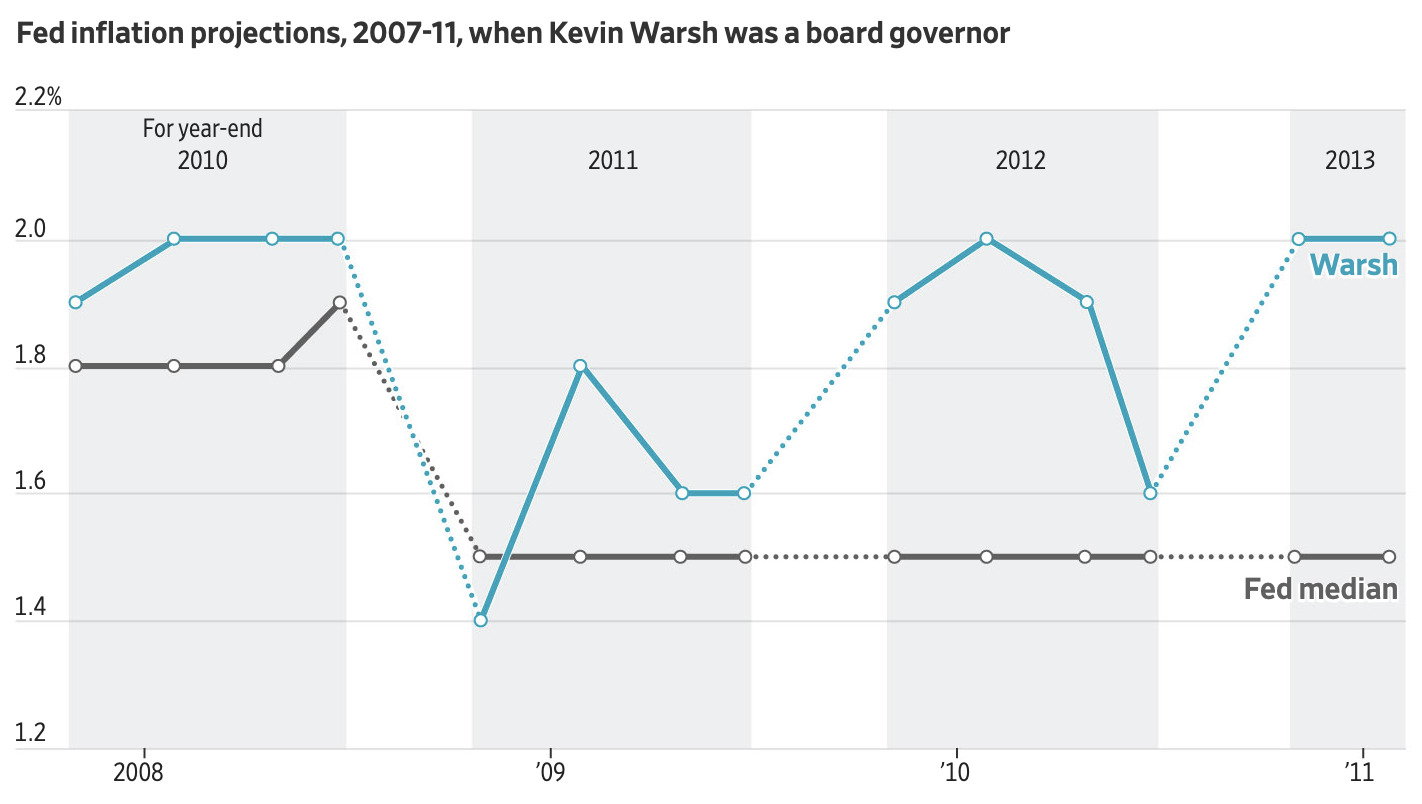
During his service as a Federal Reserve governor from 2007 to 2011, Kevin Warsh submitted quarterly projections for economic growth, unemployment and inflation. Those forecasts, released publicly years later, show that his interpretation of inflation differed from that of most colleagues after the 2007–09 financial crisis. Other officials believed unemployment near 9% represented substantial economic slack that would limit price increases. Warsh argued that this relationship had changed.
Rather than treating high unemployment as entirely temporary, Warsh believed the crisis and government policies that he considered harmful to growth had permanently increased it. In his view, the economy’s productive capacity had weakened, so it could reach its limits sooner and become vulnerable to inflation from external shocks. This approach placed more emphasis on supply conditions and public policy than on traditional demand indicators such as unemployment.
What the Old Forecasts Revealed
For many years, events did not confirm Warsh’s inflation concerns. After he left the Fed, inflation remained below officials’ expectations, while unemployment continued falling and reached 3.5% by 2020. Price pressures stayed limited even at levels of unemployment that Warsh and many colleagues had not expected. Economic growth did disappoint, as they feared, but both growth and inflation remained weak for much of the following decade.
Still, Warsh offered a distinct explanation for the disappointing expansion. He blamed regulatory, fiscal and trade policies for reducing what the economy could produce. The inflation he warned about eventually arrived about a decade later, after the pandemic and a large wave of government stimulus. Consequently, his earlier record can be interpreted in two ways: as evidence of a strong instinct against inflation or as an unconventional framework centered on supply constraints and government policy.
A Different Challenge as Fed Chairman
Today, Warsh leads the same committee whose decisions depend on how officials distinguish temporary developments from structural changes. Current conditions differ sharply from those he faced 15 years ago because unemployment is low and inflation has remained above the Fed’s 2% target for five years. Meanwhile, advances in artificial intelligence may increase productivity, expand the economy’s capacity and lower costs, although the size of that effect remains uncertain.
Because Warsh distrusts the Fed’s forecasting record, he has resisted signaling future interest rates. Forecasts became more prominent after his departure, especially when the central bank introduced the dot plot showing each official’s preferred interest-rate path. Warsh became a leading critic of that tool and declined to submit economic or rate projections at his first meeting as chairman in June. His task now is to evaluate inflation and productive capacity during a technology shock that policymakers cannot yet measure accurately.
Reference
Timiraos, N., DeBarros, A., & Santilli, P. (2026, August 24). Warsh’s old forecasts show how he formed his views on inflation. The Wall Street Journal. https://www.wsj.com/economy/central-banking/warshs-old-forecasts-show-how-he-formed-his-views-on-inflation-60efb1c7