
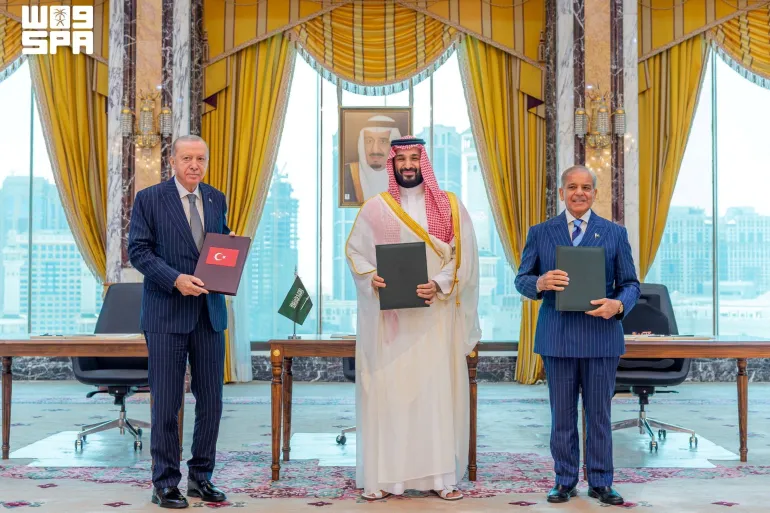
Saudi Arabia, Turkiye, and Pakistan have formally signed the “Makkah Joint Defence Agreement” in Mecca. Establishing a mutual defense pact where an attack on one signatory is treated as an attack on all three. Signed amid heightened regional instability, including the ongoing U.S.-Israel war on Iran, trade disruptions in the Strait of Hormuz, and renewed Houthi strikes on Gulf oil infrastructure.
Obviously, the trilateral framework expands upon an earlier bilateral security deal between Riyadh and Islamabad. Under the new arrangement, each nation contributes distinct strategic assets. For example, Saudi Arabia provides substantial financial capital, Turkiye brings its advanced defense technology and NATO-standard military capabilities, and Pakistan offers nuclear deterrence and significant military manpower.
While officials from all three participating nations emphasize that the pact serves as a “shield of peace” and targets no specific third party. Meanwhile security analysts broadly view the alliance as a collective deterrence signal directed toward Iran and its regional network of proxy forces. For Saudi Arabia, the agreement offers a way to diversify its security architecture beyond traditional reliance on U.S. guarantees. Meanwhile Turkiye gains expanded strategic influence across South Asia and the Gulf. Tehran has publicly dismissed the agreement as an ineffective security measure. Although experts note that Pakistan’s role as both a signatory and an active regional mediator could help shield the pact from escalating into direct confrontation with Iran.
In conclusion, the Makkah Joint Defence Agreement signals a major realigning of Middle Eastern and South Asian security architecture. By creating a unified deterrence network that merges financial, industrial, and military resources, Saudi Arabia, Turkiye, and Pakistan. Ultimately, are building a self-reliant security framework aimed at navigating regional volatility while reducing absolute dependence on Western security alliances.
Reference
Hussain, A. (2026, August 8). Saudi-Pakistan-Turkiye pact: A new shield or strategic signal? Al Jazeera. https://www.aljazeera.com/news/2026/8/8/saudi-pakistan-turkiye-pact-a-new-shield-or-strategic-signal