
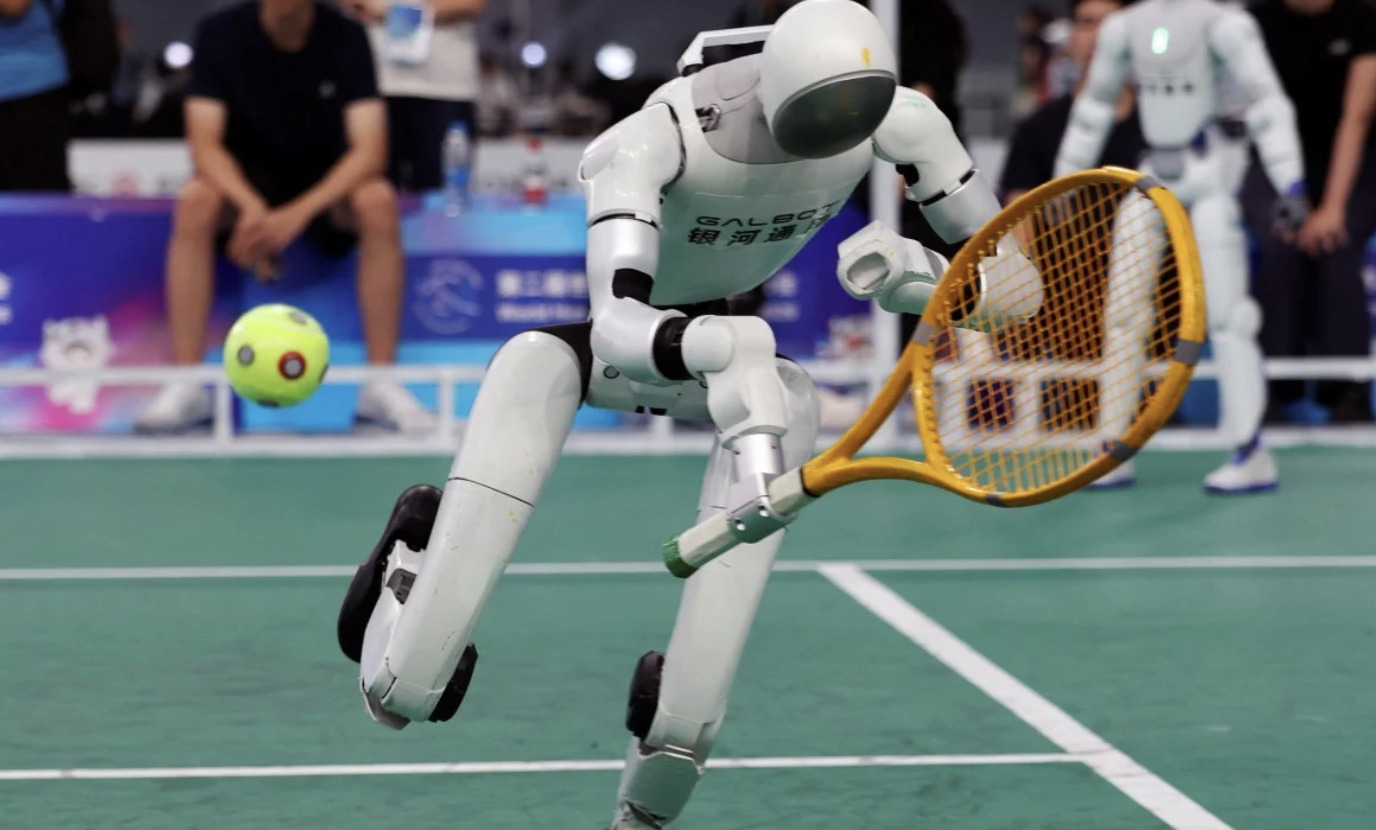
Tennis Demonstration and Expanding Events
Galbot presented what it described as the world’s first human-robot tennis match during the opening of the second World Humanoid Robot Games in Beijing. Its humanoid robot exchanged forehands and backhands with human players in singles and mixed-doubles demonstrations. After losing its balance while chasing a ball, the machine rolled over, stood up without assistance and continued playing. The performance showed both its developing athletic ability and its remaining balance problems.
Hosted at the National Speed Skating Oval used during the 2022 Winter Olympics, the five-day competition includes running, football, table tennis, kickboxing and combat events. Organisers reported 51 events and 1,301 matches involving more than 600 teams and 2,056 humanoid robots. Scenario-based competitions also cover practical tasks in industrial production, hotels, homes and logistics. Tennis is especially demanding because a robot must track the ball, predict its landing point, move into position and coordinate its torso and arms within seconds.
Record-Breaking Speed and Visible Limitations
Tien Kung robots produced striking results on the running track. One machine won the 400-metre large-robot final in 38.15 seconds, faster than the human men’s world record of 43.03 seconds. The second- and third-place robots also finished below 40 seconds. Compared with the previous year’s winning time of 88.03 seconds, these performances demonstrated a major improvement in speed.
Even shorter distances produced notable results. A Tien Kung Ultra robot developed by the Beijing Humanoid Robot Innovation Centre completed 100 metres in 9.39 seconds, beating Usain Bolt’s world-record time of 9.58 seconds. However, other moments revealed continuing weaknesses. One football robot knocked over its own teammate, while machines that fell and could not resume running had to be removed on stretchers or in wheelchairs.
Autonomy Increases Network and Battery Demands
Last year, many robots relied on remote control, so they placed relatively limited pressure on communications networks. Competitions now increasingly require autonomous operation. Beijing’s humanoid robot half-marathon demonstrated this change because a road race across a wide area needed continuous mobile coverage instead of the Wi-Fi sometimes available indoors. China Unicom executive Yang Lifan said networks have therefore become essential and will grow more important.
This year, more machines use 5G-advanced modules to transmit sensor data to embodied-intelligence systems and receive instructions in return. Battery life remains a major constraint because movement motors already consume much of a robot’s available power. Huawei executive David Li explained that running artificial-intelligence computing directly on the machine would increase consumption further. Consequently, some manufacturers are moving more processing to the cloud, conserving on-board energy for movement while making reliable network coverage increasingly necessary.
Reference
Liu, H., & Liu, H. (2026, 23 agosto). Chinese robots tackle tennis, smash track records at World Humanoid Robot Games. South China Morning Post. https://www.scmp.com/tech/tech-trends/article/3364977/chinese-robots-tackle-tennis-smash-track-records-world-humanoid-robot-games?share=e7D8KZ%2BBEzEkH%2B5WqCpim6c6Th%2BCWY4BCyUgza%2Fb0mTVPOUg9%2Bya5NMj8lCxI1TbNm8TrLpdbu7tARw4AOb%2Fy8yGtKx1T7S76%2FGeZstOmlo%3D&utm_campaign=social_share