
A devastating glacier collapse.
The flash floods on the Nepal-Tibet border killed 584 people by Friday afternoon, including 579 in Nepal and five in Tibet, while 1,942 people remained missing. The IFRC estimated that at least 93,000 people had been affected and were in great need. The disaster began when a massive section of a Himalayan glacier broke loose in Nepal’s Langtang National Park, releasing water, mud, rocks and ice through rivers and valleys. Villages were destroyed, along with power stations, roads and bridges. More than 40 bridges and 40 kilometres of roads were damaged or destroyed.
Rescue efforts under dangerous conditions.
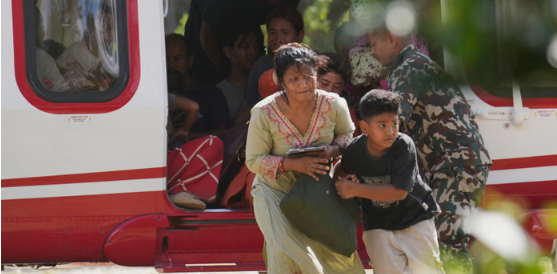
Rescue operations have faced severe obstacles because landslides destroyed roads and bridges, leaving many areas accessible only by helicopter. Teams recovered bodies hundreds of miles downstream in Nepal’s Chitwan district, while dozens of injured people were transported to Kathmandu. Nepali army helicopters rescued more than 100 people. Operations were temporarily suspended after a debris lake near the border overflowed, raising fears of another flood. In Rasuwa, residents rushed towards higher ground, while Bidur authorities ordered people to evacuate again as the Trishuli River began rising.
Communities devastated by the floods.
Bidur, once a busy town beside the Trishuli River, suffered extensive destruction, with most homes washed away by mud, rocks and debris. Survivors described clinging to buildings and trees as the water swept through the valley. Residents later searched for missing relatives and attempted to recover their belongings from the ruins. The disaster also affected hundreds of foreign nationals who were in the region for work, trekking or pilgrimage. The Red Cross warned that the death toll could continue rising as rescuers reach previously inaccessible areas and assess the full scale of the destruction.
International assistance and climate risks.
The international community has offered support as Nepal continues its rescue operation. India, China, the United States, Britain, Japan, South Korea, Sri Lanka and Bangladesh asked to send search and rescue teams, although Nepal said its own agencies were handling the emergency. The disaster also highlights the growing vulnerability of Himalayan communities to melting glaciers, intense monsoons and climate change. Information from Tibet remains limited, with Chinese authorities confirming only five deaths. The destruction demonstrates how extreme weather can overwhelm infrastructure while simultaneously making humanitarian assistance more difficult to deliver.
Reference
Ellis-Petersen, H., Jones, S., & agencies. (2026, August 28). At least 93,000 ‘in great need’ after Nepal-Tibet flash floods, says Red Cross. The Guardian. https://www.theguardian.com/world/2026/aug/28/nepal-tibet-flash-floods-red-cross-rescuers-death-toll