
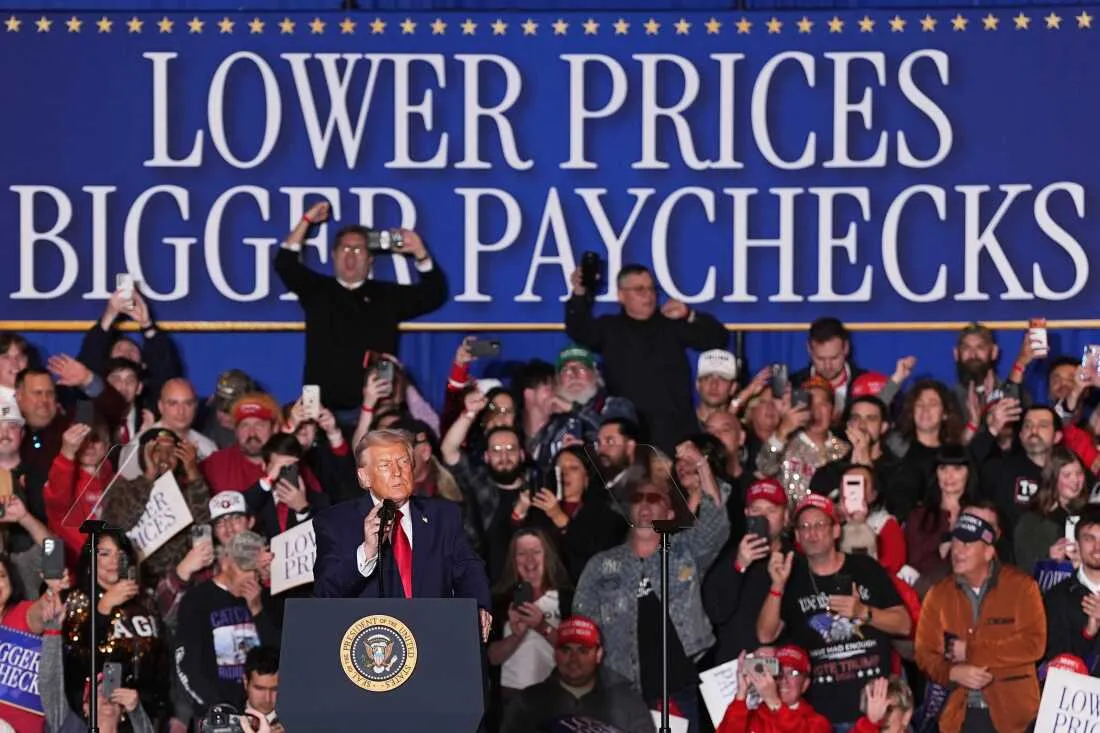
Donald Trump recently spoke in Pennsylvania for the launch of the“affordability tour.” In the speech he revealed far more about his political strategy and its weaknesses, than about any actual plan to improve Americans’ financial situation. Although the event was presented as outreach to working-class voters, the luxury casino venue symbolized the fundamental disconnect between Trump’s messaging and the economic frustrations many people feel.
Rather than acknowledging any economic difficulties, Trump doubled down on an alternate reality in which the country’s financial performance is flawless. The president graded the economy as “A-plus-plus-plus-plus-plus” and insisted that only biased media and confused citizens think otherwise. The review highlights the central inconsistency. Trump cannot blame Democrats for economic problems without admitting those problems exist. Therefore, he denies the premise entirely and portrays public dissatisfaction as ignorance.
His administration’s posture mirrors this approach. Treasury Secretary Scott Bessent’s remark that “the American people don’t know how good they have it”. A tone-deaf message that frames legitimate economic concerns as a perception error rather than a policy failure. The piece argues that this position is politically self-destructive, especially given Trump’s lack of empathy and refusal to acknowledge the realities facing voters.
The Self-Inflicted Roots of America’s Economic Anxiety
It was also noted that Trump’s own actions have contributed to widespread economic unease. He campaigned on promises of dramatic price declines beginning “day one,” yet inflation persists, leaving supporters feeling misled. In addition, instead of maintaining the relatively stable economic trajectory inherited from the previous administration, he introduced abrupt and destabilizing policies. Steep tariffs, disruptions linked to cryptocurrency shifts, aggressive immigration enforcement, and volatile foreign actions, are only a few examples. These choices undercut the nostalgic sense of stability that helped him win support in 2024.
Looking ahead, more turbulence is expected. Rising health-insurance premiums as subsidies lapse and the likelihood that retailers will soon pass tariff-driven costs onto consumers. As a result, Trump’s “affordability tour” begins not with a coherent message but with a contradiction. One insisting that Americans are wrong about their own economic struggles while simultaneously making policy decisions that intensify those struggles.
Ultimately, the review’s core assessment is clear. Trump’s biggest political liability is not public misunderstanding but the economic instability generated by his own decisions. Accompanied by his refusal to acknowledge this reality ensures the situation is unlikely to improve.
Reference
Krugman, P. (2025, December 10). Trump says that you are the problem. Paul Krugman. https://paulkrugman.substack.com/p/trump-says-that-you-are-the-problem?utm_source=share&utm_medium=android&r=59ocs7&triedRedirect=true