

From predictions to practice: What AI usage data reveals about the future of work
The recent World Bank blog post analyzing AI usage data from Anthropic marks a shift from theoretical projections to observable behavior. Until now, most research relied on “exposure” indices—estimates of how vulnerable occupations might be to AI disruption. The key question was whether those predictions actually matched real-world adoption.
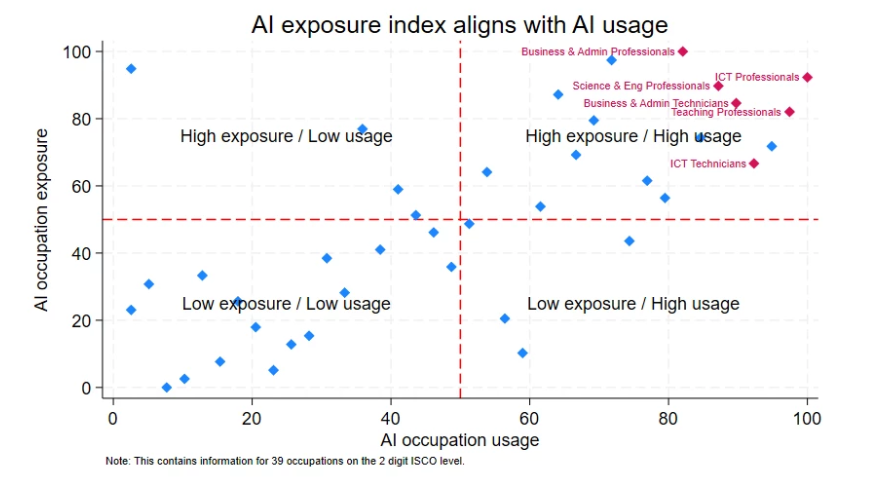
The evidence suggests that they largely do. Exposure indices, such as AI Occupational Exposure measures, strongly correlate with actual AI usage patterns. In other words, predictions about which jobs would be most affected by AI align closely with how workers are using generative AI tools in practice (see Figure 1).
Exposure and Adoption: Predictions Confirmed
The comparison between predicted exposure and real AI usage reveals a strong alignment. Occupations with high predicted exposure tend to show high usage, while low-exposure occupations show limited adoption. Few jobs fall into the “mismatch” categories of high exposure but low usage or vice versa (Figure 1).
ICT professionals lead both in exposure and actual AI use. This is intuitive: they have infrastructure access, digital literacy, and immediate productivity incentives. More intriguing is the managerial gap. Managers display high exposure but relatively low usage. Possible explanations include privacy concerns, time constraints, and institutional resistance. This mismatch may shape how AI diffusion unfolds within organizations.
A Stark Global Divide in AI Usage
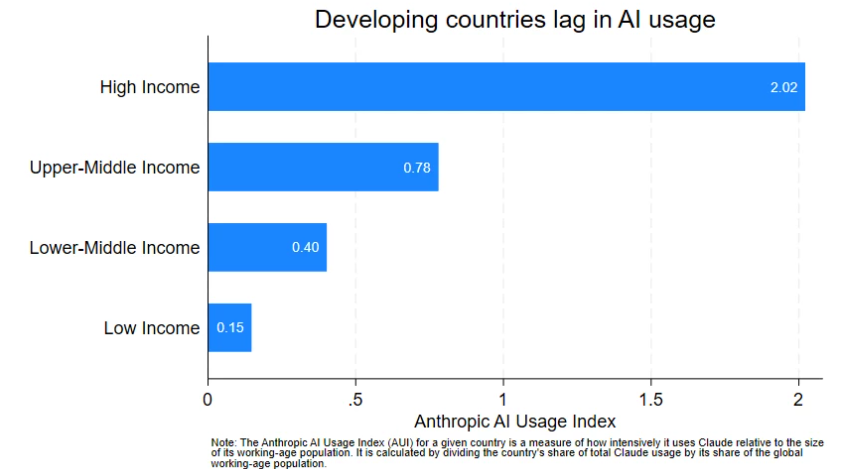
The second major finding concerns international inequality. The Anthropic AI Usage Index shows that only high-income countries have usage levels above the global per-capita benchmark. High-income economies average an index of 2.02, while middle-income countries remain far below one. Low-income countries barely register measurable usage (see Figure 2).
This gap suggests a structural divergence. AI-driven productivity gains are concentrated in advanced economies. If this pattern persists, developing countries risk losing competitiveness in labor-intensive sectors as automation accelerates reshoring.
Concentration of Usage in Middle-Income Countries
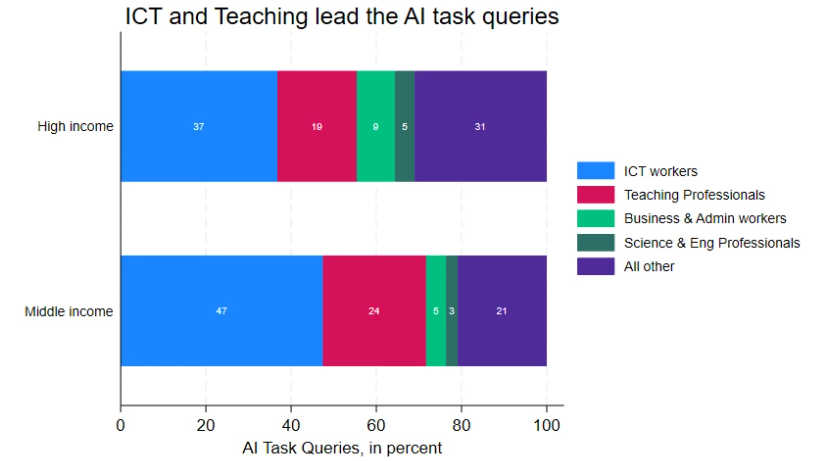
Not only is usage lower in middle-income countries—it is also more concentrated. ICT workers account for nearly half of AI queries, and teaching professionals represent another significant share (Figure 3). Together, these two groups comprise almost three-quarters of usage in middle-income contexts.
In contrast, usage in high-income countries is more diversified across occupations. This concentration reflects differences in infrastructure, access, and digital skills. It also signals uneven diffusion across labor markets.
Policy Implications: Inclusion or Exclusion?
Three strategic implications emerge from the analysis of AI usage data. First, exposure indices remain valuable policy tools because they predict adoption patterns. Second, AI adoption follows a diffusion curve—starting with technologically advanced professions before spreading outward. Third, the adoption divide is not self-correcting.
Without deliberate investment in digital infrastructure, skills development, and enabling policy environments, low- and middle-income countries may experience a new form of technological exclusion. Given that over a billion young people will enter the labor force in developing countries over the next decade, this is not a theoretical issue—it is a development priority.
Reference
Demombynes, G., Langbein, J., & Weber, M. (2026, February 19). From predictions to practice: What AI usage data reveals about the future of work. World Bank Blogs. https://blogs.worldbank.org/