
The Rise of Human-AI Collaboration
First, generative artificial intelligence is expected to transform knowledge work and organizational collaboration. However, the central challenge is determining how teams can use AI while preserving human creativity, judgment, and agency.
Therefore, new collaborative models are emerging that combine human expertise with the speed and analytical capacity of AI tools.
Defining “Vibe Teaming”
In this context, vibe teaming describes a model of human-human-AI collaboration designed to strengthen collective intelligence within teams.
More specifically, AI tools are integrated directly into teamwork processes to capture discussions, organize ideas, and generate early drafts of knowledge outputs.
Consequently, AI supports routine tasks while humans concentrate on strategic thinking, collaborative exploration, and complex problem-solving.
Collective Sensemaking as the Core Process
At the center of vibe teaming lies collective sensemaking, a process where individuals combine perspectives to build shared understanding of complex issues.
Through dialogue and reflection, teams synthesize diverse expertise and gradually produce insights that no single member could generate alone.
Thus, AI acts as a catalyst that accelerates synthesis while humans shape interpretation, judgment, and strategic direction.
How the Method Works in Practice
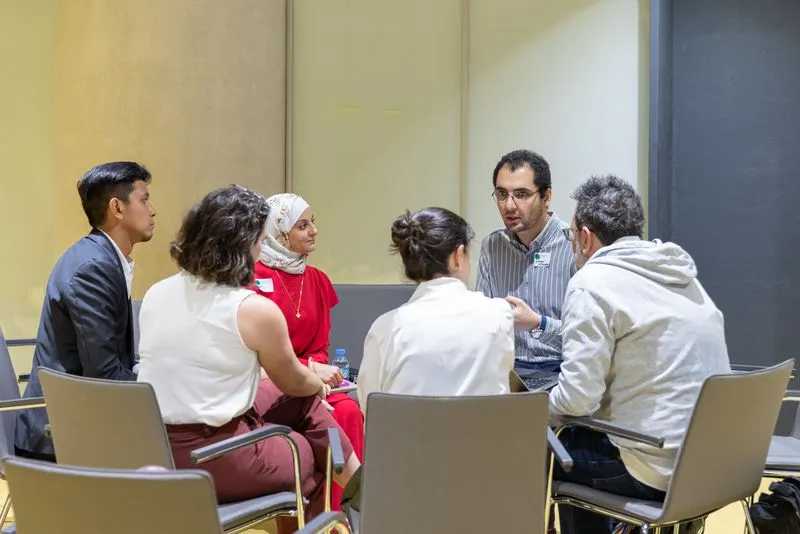
Typically, the process begins with a rich conversation between experts discussing a problem and potential solutions.
Next, AI systems transcribe the dialogue, analyze patterns, and generate structured drafts or summaries from the conversation.
Afterward, humans review, refine, and validate the output, ensuring accuracy, nuance, and contextual understanding.
As a result, teams can move rapidly from discussion to structured knowledge products such as policy briefs or strategies.
Evidence from Early Experiments
For example, one experimental session lasting only ninety minutes produced a high-quality strategy addressing the global challenge of ending extreme poverty.
Overall production required only a few hours, suggesting a dramatic reduction in the time traditionally needed for comparable research outputs.
Benefits for Knowledge Work
Importantly, vibe teaming shifts team effort away from repetitive documentation tasks toward deeper collaboration and synthesis.
Moreover, integrating AI early in the workflow can increase efficiency, accelerate insight generation, and strengthen collaborative thinking.
Therefore, organizations may use this approach to address complex global problems requiring interdisciplinary cooperation.
Risks and Design Considerations
Nevertheless, the approach introduces potential risks such as bias, over-reliance on AI outputs, and uneven access to advanced tools.
Consequently, teams must establish safeguards including critical review, transparency, and deliberate dissent during collaboration.
Toward a New Model of Teamwork
Ultimately, vibe teaming suggests that the future of knowledge work will depend less on individual productivity and more on enhanced collective intelligence.
Thus, the most powerful outcomes may emerge when human expertise, collaborative dialogue, and AI-driven synthesis operate together in integrated teams.
Source:
Brookings Institution. (2025). Vibe teaming and collective sensemaking. https://www.brookings.edu/articles/vibe-teaming-collective-sensemaking/