

World Bank. AI for Social Risk Forecasting and Explanation: The Power of Machine Learning–Based Social Risk Models.
The paper explores how artificial intelligence (AI) and machine learning can improve the forecasting and explanation of social risks such as conflict, migration, and crime.
The authors argue that traditional methods struggle to capture the complexity of social phenomena, especially in contexts affected by multiple overlapping crises (“polycrisis”). Machine learning offers a way to process vast datasets and identify patterns that are otherwise difficult to detect.
Key challenges in social risk modeling
One major limitation of conventional approaches is their inability to handle the multidimensional and dynamic nature of social risks. As noted, social risks arise from complex interactions between economic, political, environmental, and perceptual factors, which are constantly evolving.
Another challenge is data scarcity and inconsistency. Many social phenomena—such as crime or migration—are poorly measured, especially in developing regions. This lack of reliable data reduces the accuracy of traditional forecasting models.
Additionally, human perception plays a critical role. The report highlights that perceived exclusion or inequality can be more influential than objective conditions in driving outcomes like violence, making modeling even more complex.
Methodology and models
The World Bank developed three proof-of-concept machine learning models to demonstrate practical applications:
- Conflict model (Democratic Republic of Congo): Achieved validation accuracy between 63% and 76%, predicting changes in violence levels.
- Migration model (Horn of Africa): Reached 70–74% accuracy by analyzing population movements using satellite imagery and socioeconomic data.
- Crime model (Small Island Developing State): Generated proxy data from online news sources to forecast crime trends with an average deviation of about 12.9%.
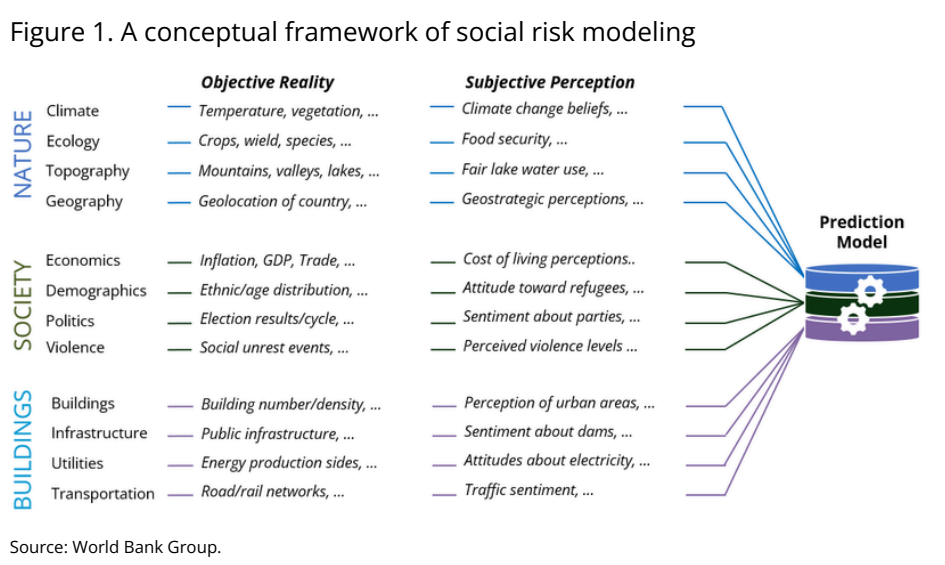
These models integrate diverse data sources, including satellite imagery, social media language, economic indicators, and climate data. According to the framework diagram, they combine “objective reality” (e.g., economic data) with “subjective perception” (e.g., public sentiment) to improve predictions.
Key findings and implications
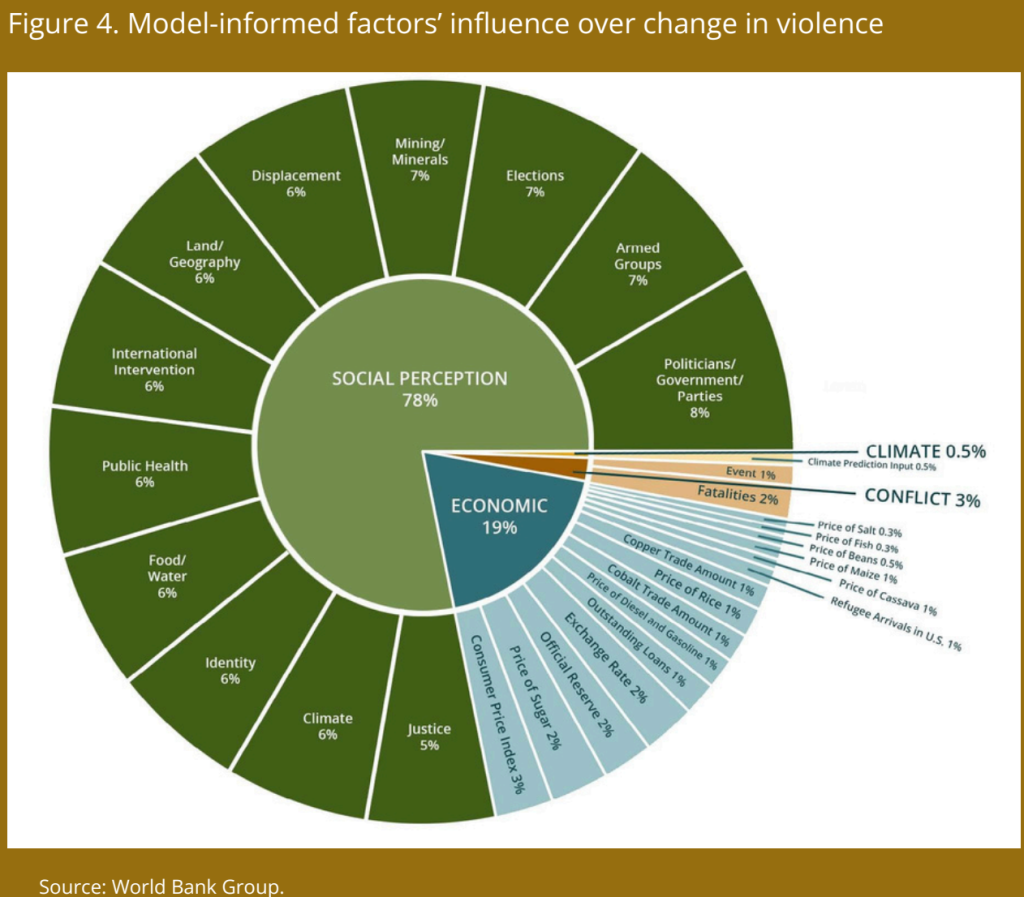
The models reveal that social perceptions—such as political sentiment or public discourse—are among the strongest predictors of changes in social risks. For example, the chart shows that social perception accounts for the majority of influence in predicting violence, surpassing economic or climate factors.
The study concludes that AI-based models can significantly enhance development policy by enabling:
- Better risk monitoring and early warning systems
- More precise allocation of resources
- Evidence-based policy design
Reference
Mahony, C., Vemuru, V., Rahim, A., & Owen, D. (2026). AI for social risk forecasting and explanation: The power of machine learning–based social risk models. World Bank. https://hdl.handle.net/10986/44662