
The Transition from Domestic Critique to Global Moral Leadership
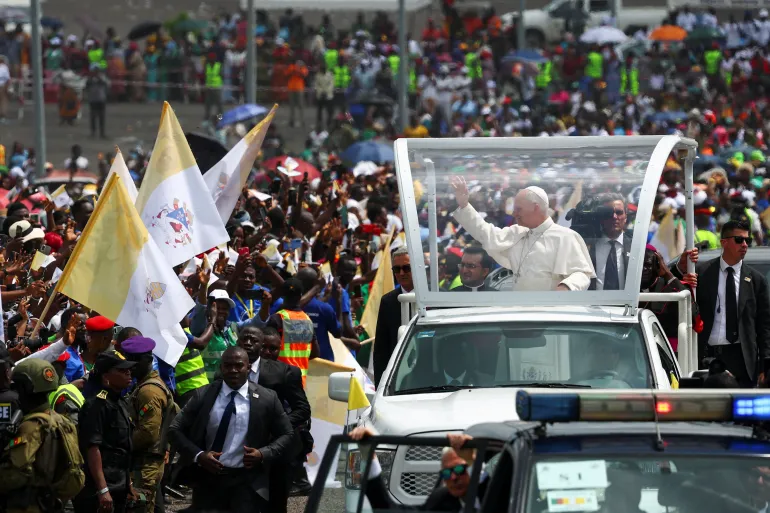
By mid-April 2026, Pope Leo XIV—the first U.S.-born pontiff—has transitioned from being a “national curiosity” in America to the world’s most vocal critic of the administration’s military doctrine. As he arrives in Angola, the third leg of his four-country Africa tour, the report highlights that his message has evolved from a simple call for peace to a systemic critique of “tyranny” and “global exploitation.” Consequently, the visit to fossil-fuel-rich Angola is being framed as a direct challenge to the “Stone Age” energy blockade (Article #105). This suggests that the Vatican is positioning itself as the “conscience of the Global South” in direct opposition to the U.S.-led “total victory” strategy.
Origins and the “Personalized” Feud with Washington
Originally, Pope Leo was expected to be a pragmatic bridge between the Vatican and his home country. However, the origin of the current “clash” lies in the Pope’s outspoken condemnation of the April 7 “Civilization” threat (Article #1.1), where he called the rhetoric “unacceptable” for a modern leader. For 2026, this has devolved into a historic verbal feud; the report emphasizes that while Leo was preaching to 120,000 people in Cameroon, President Trump was attacking him on social media, accusing the Pope of being “terrible for foreign policy” and “weak on crime.” Furthermore, the AI-Jesus Image Controversy (Article #3.3) has turned a political disagreement into a deeply personal religious rift between the White House and the Holy See.
The Structure of the “Angola Dialogue”
The structure of the Pope’s visit to Luanda is organized around three strategic themes:
- Ecological Sovereignty: In a country dependent on oil exports, Leo is expected to speak on the “exploitation of the land,” echoing his Laudato si’ predecessors but updated for the 2026 Electrostate transition (Article #112).
- The “Handful of Tyrants” Rhetoric: The report notes that Leo has begun using increasingly sharp language, referring to a “delusion of omnipotence” among world leaders who prioritize military escalation over the lives of the innocent.
- Institutional Friction: The article highlights the tension within the African Union, as many leaders are torn between welcoming the Pope’s message and maintaining their precarious security ties with the U.S. during the ongoing Iran war.
Synthesis of “Soft Power” and the New Bipolarity
The successful conclusion of this tour now faces a paradox: while Pope Leo has won the “Narrative War” (Article #111) alongside Iranian Lego videos and European activists, he lacks the Structural Power to lift the blockade. This represents a return to the Cold War-era “Vatican Ostpolitik,” where the Pope acts as a “third force” between two clashing giants. There is a clear intent in Rome to prove that the “moral voice” can still move millions, even when the “military voice” controls the seas. Ultimately, it is clear that in 2026, the real battlefield isn’t just the Strait of Hormuz; it’s the hearts of the global majority, and Leo XIV is currently holding the ground.
ReferenceAl Jazeera. (2026, April 18). Pope Leo heads to Angola in landmark Africa visit amid Trump clash. Al Jazeera News Africa. https://www.aljazeera.com/news/2026/4/18/pope-leo-heads-to-angola-in-landmark-africa-visit-amid-trump-clash