
The Transition from Regional Insurgency to Global Terror Node
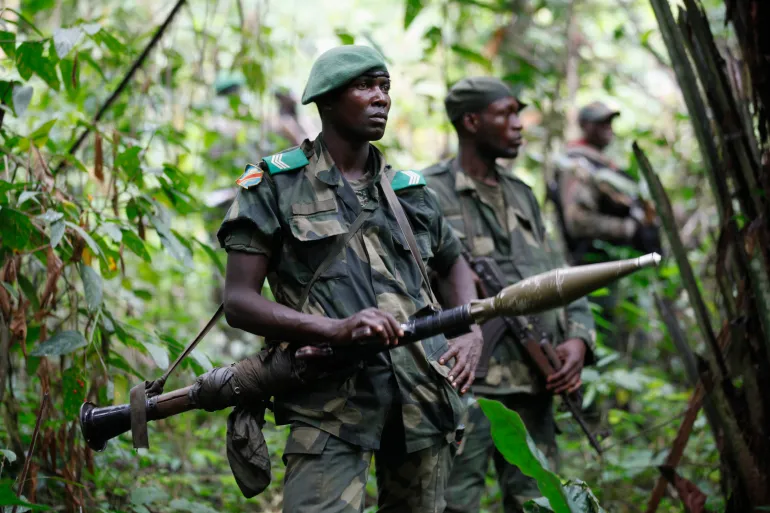
By April 20, 2026, the security landscape in the eastern Democratic Republic of the Congo (DRC) has transitioned from localized militia violence to a coordinated front against a globalized threat. A successful joint operation by Ugandan and Congolese forces resulted in the rescue of 200 civilians from the Allied Democratic Forces (ADF). Consequently, the focus has shifted toward the growing operational links between the ADF and the Islamic State (ISIL), which has transformed this long-standing rebellion into a critical node of international terrorism. This suggests that the “Shujaa” operation is no longer just a border security mission, but a vital component of the broader counter-terrorism efforts in Sub-Saharan Africa.
Origins and the Evolution of the “Shujaa” Operation
Originally, the ADF was an Ugandan insurgent group that retreated into the dense forests of the DRC in the 1990s. However, the origin of the current high-stakes conflict lies in the group’s 2019 pledge of allegiance to ISIL, which brought an influx of foreign financing and extremist ideology. For 2026, the joint military response represents a rare moment of institutional cooperation between Kampala and Kinshasa, despite decades of mutual distrust. The report emphasizes that while the rescue of 200 people is a tactical victory, the group’s ability to maintain “invisible” forest networks remains a significant challenge to the region’s stability and the safety of its civilian population.
The Structure of the Counter-Insurgency Friction
The structure of the military effort against the ADF is organized around three layers of strategic and logistical friction. First is the terrain challenge, where the vast, unmapped expanses of the Rwenzori Mountains and the Ituri forest provide the insurgents with a natural fortress that negates the conventional air superiority of the joint forces. Second is the intelligence gap, as the report notes that the ADF has become highly adept at blending into local communities or using forced labor to maintain their supply lines. Finally, the article highlights the institutional friction regarding the long-term presence of Ugandan troops on Congolese soil, a sensitive political issue that threatens to undermine the coalition if a definitive victory is not achieved quickly.
Synthesis of the Security-Development Nexus
The successful rescue of these civilians now faces a paradox where “military liberation” does not automatically lead to “social reintegration.” This represents the security-development nexus in political science, where the absence of state services and economic opportunities in the liberated zones creates a vacuum that extremist groups can easily re-exploit. There is a clear intent in the Al Jazeera report to show that the ADF threat is evolving faster than the regional governments’ ability to provide governance. Ultimately, it is clear that for 2026, the fight in the DRC is a test of whether regional military cooperation can survive the immense pressure of a globalized insurgency.
Reference
Al Jazeera. (2026, April 20). Ugandan and Congolese forces rescue 200 from ISIL-backed ADF. Al Jazeera News Africa. https://www.aljazeera.com/news/2026/4/20/ugandan-and-congolese-forces-rescue-200-from-isil-backed-adf