
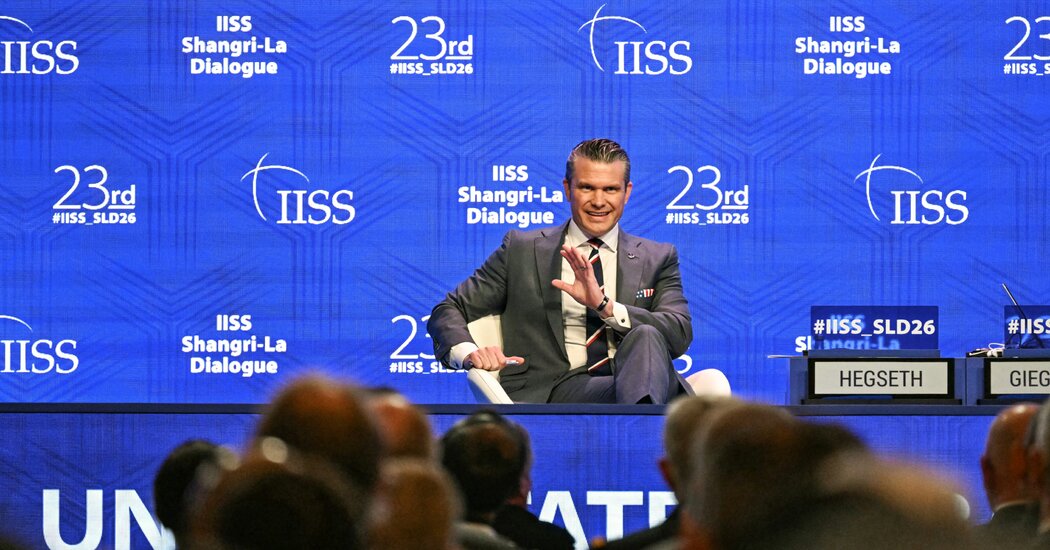
The aggressive and transactional rhetoric used by U.S. Secretary of Defense Pete Hegseth at the Shangri-La Dialogue in Singapore signals a combative shift in Washington’s Indo-Pacific foreign policy. Speaking at Asia’s premier security forum, Hegseth departed from traditional diplomatic norms. By openly challenging China, criticizing existing regional alliances, and issuing a stark warning that Asian nations must pick a side between the United States and Beijing. Analysts note that his blunt approach reflects a broader “America First” strategy under the current administration. In which prioritizes raw American power and bilateral concessions over multi-lateral diplomacy and long-standing mutual defense agreements.
In addition, throughout the forum, Hegseth continuously pressured regional allies to significantly increase their own defense spending. Making it clear that Washington views security partnerships through a highly transactional lens. He explicitly questioned the long-term value of traditional alliances if partner nations fail to bear a larger financial and military burden. This rhetoric has sparked deep anxiety among Southeast Asian leaders. In short, who have spent decades carefully navigating geopolitical competition to avoid becoming caught in a direct conflict between the world’s two largest superpowers. Rather than offering reassurance of American commitment, Hegseth’s ultimatum-driven talking points have forced regional partners to confront a more volatile and unpredictable United States.
Furthermore, the reactions from regional delegates and security experts at the summit underscore a growing fear that Hegseth’s combative posture will accelerate militarization. Therefore, heighten the risk of miscalculation in the South China Sea and Taiwan Strait. While some hawkish factions in Washington and allied capitals like Tokyo may welcome a more assertive stance against China’s expansion. The majority of Asia-Pacific nations view the administration’s uncompromising approach as a threat to regional stability. By demanding absolute alignment and reducing complex security pacts to financial transactions, Hegseth’s comments have highlighted a stark reality. Obviously, U.S. foreign policy has shifted toward an era of intense, zero-sum confrontation that leaves little room for middle-ground diplomacy in Asia.
In conclusion, U.S. Defense Secretary Pete Hegseth’s polarizing comments at the Shangri-La Dialogue signal a major shift toward a transactional, zero-sum foreign policy in the Indo-Pacific. By demanding that Asian nations choose between Washington and Beijing while simultaneously pressuring allies to pay more for their own defense. The U.S. has triggered widespread anxiety across a region that prefers diplomatic neutrality. Ultimately, this combative “America First” posture risks undermining traditional security partnerships. Above all, accelerating regional militarization, and alienating critical allies who view Washington’s unpredictable ultimatums as a threat to stability rather than a safeguard against China.
Reference
Khalili-Tari, D. (2026, May 30). What Hegseth’s comments at Shangri-La Dialogue say about US foreign policy. Al Jazeera. https://www.aljazeera.com/news/2026/5/30/what-hegseths-comments-at-shangri-la-dialogue-say-about-us-foreign-policy