
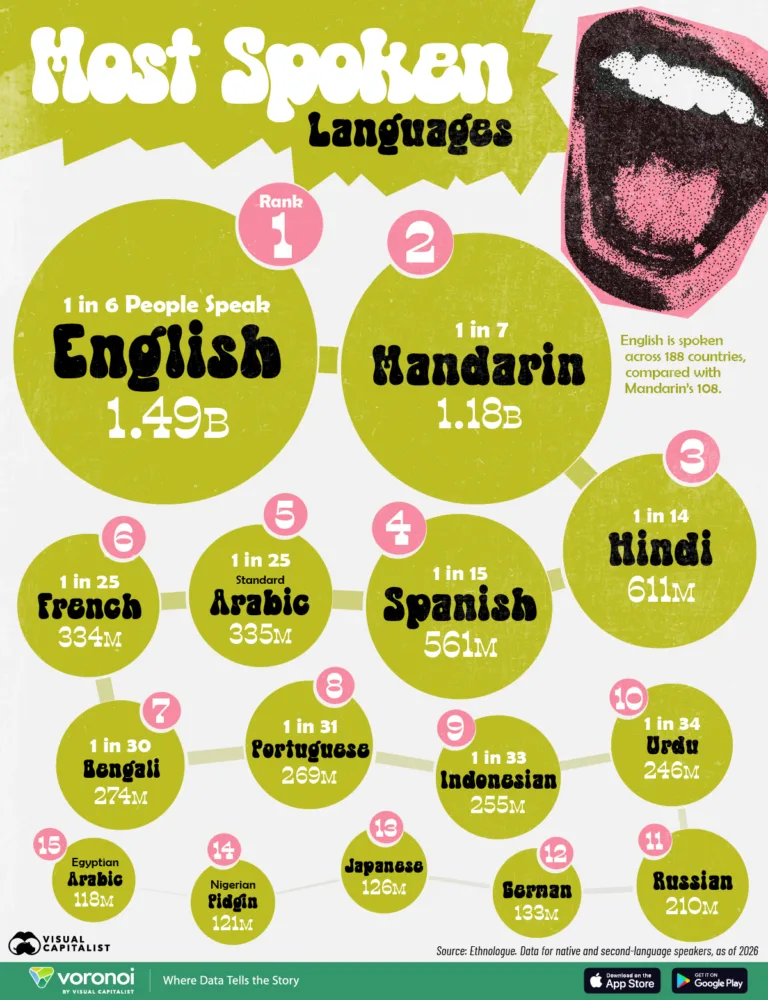
Global demographics are rapidly shifting, directly influencing how the international community communicates and conducts business. Specifically, recent data visualizations tracking the evolution of linguistics highlight a fascinating shift in global communication patterns. Because of this, international corporations and educators are actively adjusting their long-term strategies to align with these emerging demographic realities.
The most spoken Languages 2026: Top Contenders
Primarily, English continues to hold its position firmly as the dominant lingua franca for international trade, science, and technology. According to demographic experts at Ethnologue, Mandarin Chinese retains the absolute highest number of native speakers, heavily concentrated in East Asia. In fact, when reviewing the most spoken languages 2026, Hindi shows one of the most significant global growth rates, driven directly by India’s rapidly expanding and remarkably young population.
Moreover, Spanish maintains its massive influence across the Americas and parts of Europe, serving as a critical bridge for cultural and economic exchange. Consequently, multinational corporations are prioritizing multilingual capabilities to penetrate these distinct, high-volume consumer bases. As a result, linguistic diversity is increasingly viewed by executives as a crucial economic asset rather than just a cultural metric.
Cultural Shifts and Digital Connectivity
On the other hand, the exponential rise of digital connectivity is fundamentally altering how secondary languages are learned and adopted. For example, Arabic and French continue to expand rapidly across the African continent due to high birth rates and growing mobile internet access. Furthermore, the core data behind the most spoken languages 2026 underscores how regional economic booms actively accelerate language adoption globally.
Fundamentally, while these massive linguistic giants expand their reach, linguists warn that the preservation of indigenous and regional dialects remains a significant challenge. Secondly, the rapid proliferation of smartphone applications and AI translation tools is fundamentally bridging communication gaps, making cross-border business more accesible.
Preparing for a Multilingual future
Additionally, the intersection of language expansion and economic power is absolutely undeniable in today’s highly competitive, globalized market. Surprisingly, while English has historically dominated the internet’s infrastructure, current statistics reveal that the fastest-growing digital communities are interacting almost entirely in localized, non-English languages.
Conversely, companies that fail to localize their marketing content risk isolating themselves from the world’s fastest-growing consumer economies. For instance, localized digital campaigns in Hindi or Spanish consistently outperform generic translated materials in engagement metrics. In conclusion, tracking the most spoken languages 2026 provides essential, data-driven insights into exactly where global power, culture, and commerce are actively converging.
Reference: Visual Capitalist. (2026). Ranked: The World’s Most Spoken Languages in 2026. https://www.visualcapitalist.com/ranked-the-worlds-most-spoken-languages-in-2026/