
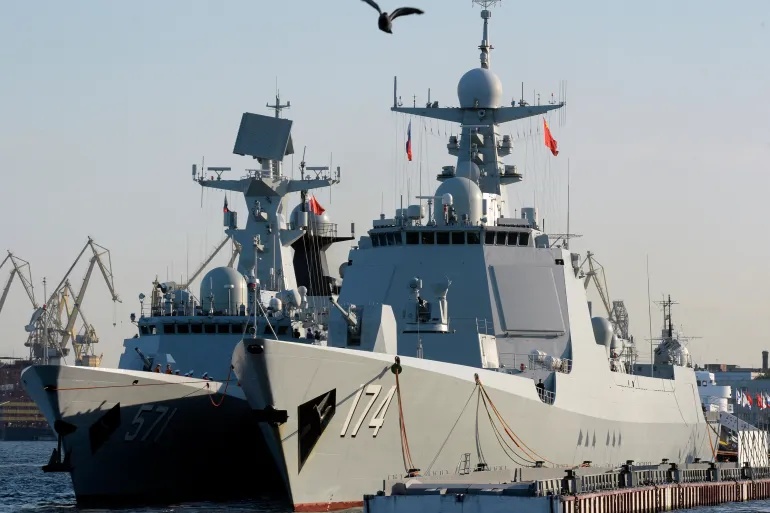
The Chinese and Russian navies are launching their annual joint military exercises. Which will take place in the waters and airspace off China’s eastern coast near the major port of Qingdao. Following the week-long drills, the two nations are scheduled to conduct joint maritime patrols in unspecified areas of the Pacific Ocean. Russia’s Pacific Fleet has deployed a cruiser, a corvette, a diesel-electric submarine, and a rescue vessel to the region.
China’s Northern Theatre Command is matching this presence with two destroyers, a frigate, a submarine, a supply ship, and its own rescue vessel. The operations are designed to focus on high-level naval maneuvers, including reconnaissance, air and missile defense, and surface-strike exercises.
These latest military maneuvers come roughly two months after a high-profile summit. Where the leadership of both nations reaffirmed their deep strategic alignment, describing their bilateral partnership as unyielding and at an unprecedented level. The two global powers have been conducting these “Joint Sea” exercises regularly since 2012. With the previous iteration held near the Russian port of Vladivostok before expanding into Pacific patrols. While Beijing maintains a publicly neutral stance on the conflict in Ukraine and frequently calls for peace negotiations. Obviously, it has notably never condemned Moscow’s full-scale invasion, and these drills emphasize their enduring economic and diplomatic ties.
In conclusion, the continuation and expansion of these joint naval maneuvers signal a deepening strategic and military alignment between Beijing and Moscow despite intense international scrutiny. By conducting sophisticated defense drills and Pacific patrols. Both nations are projecting unified maritime power and signaling to global rivals that their geopolitical partnership remains resilient. Ultimately, the exercises demonstrate that their “unyielding” relationship is actively translating into concrete security cooperation. In short, reinforcing a shared counterweight to Western influence in the Indo-Pacific region.
Reference
Bah, M. (2026, July 5). China and Russia to hold annual joint naval drills. Al Jazeera. https://www.aljazeera.com/news/2026/7/5/china-and-russia-to-hold-annual-joint-naval-drills