
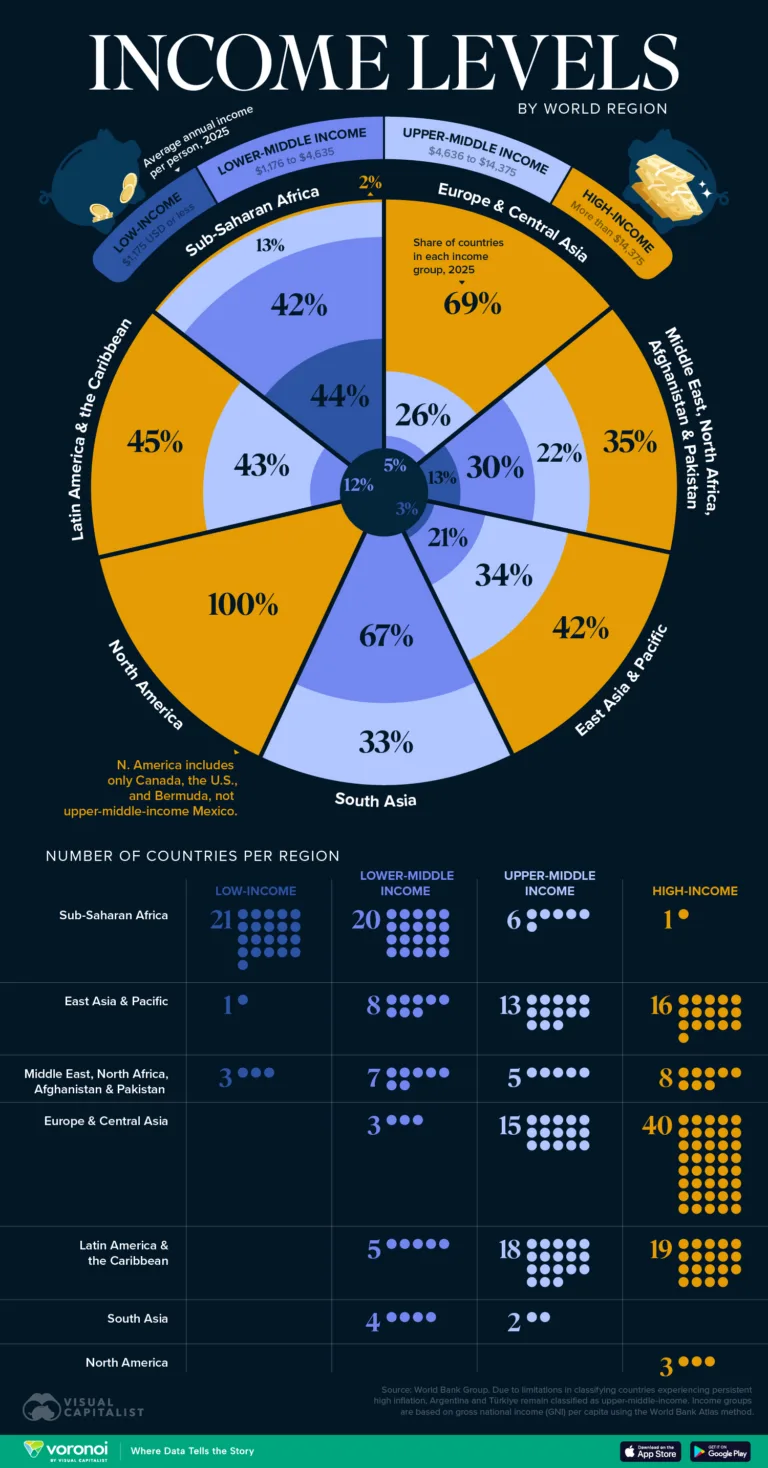
According to World Bank regional income classifications, the geographic concentration of high income countries world regions displays striking development contrasts across continents. While advanced economies cluster heavily in North America and Western Europe, middle- and low-income tiers dominate vast portions of the global south. Consequently, evaluating regional shares of high-income nations highlights persistent structural disparities in global economic development.
Structural Development Gaps Across Continents
Data reveals that national wealth remains heavily concentrated in industrialized regions supported by robust infrastructure and established financial systems. For instance, both North American nations fall into the highest income bracket, followed closely by Western Europe and members of the Gulf Cooperation Council.
“Economic geography and integration into high-value global supply chains continue to dictate which regions cross high-income thresholds,” noted development analysts.
Specifically, cross-border trade integration, technological innovation, and strong institutional frameworks permitted several East Asian economies to transition rapidly into upper-tier classifications.
Challenges for Equitable Global Growth
Conversely, Sub-Saharan Africa and South Asia exhibit the lowest proportion of high-income economies. In these areas, reliance on unprocessed commodities and demographic pressures continue to restrict growth in Gross National Income (GNI) per capita.
Therefore, encouraging industrial diversification and capital investment remains crucial for narrowing regional disparities. Ultimately, tracking the distribution of high income countries world regions helps international policymakers design targeted trade, aid, and development strategies.
Routley, N. (2026, July 28). Which world regions have the most high-income countries?. Visual Capitalist. https://www.visualcapitalist.com/which-world-regions-have-the-most-high-income-countries/