
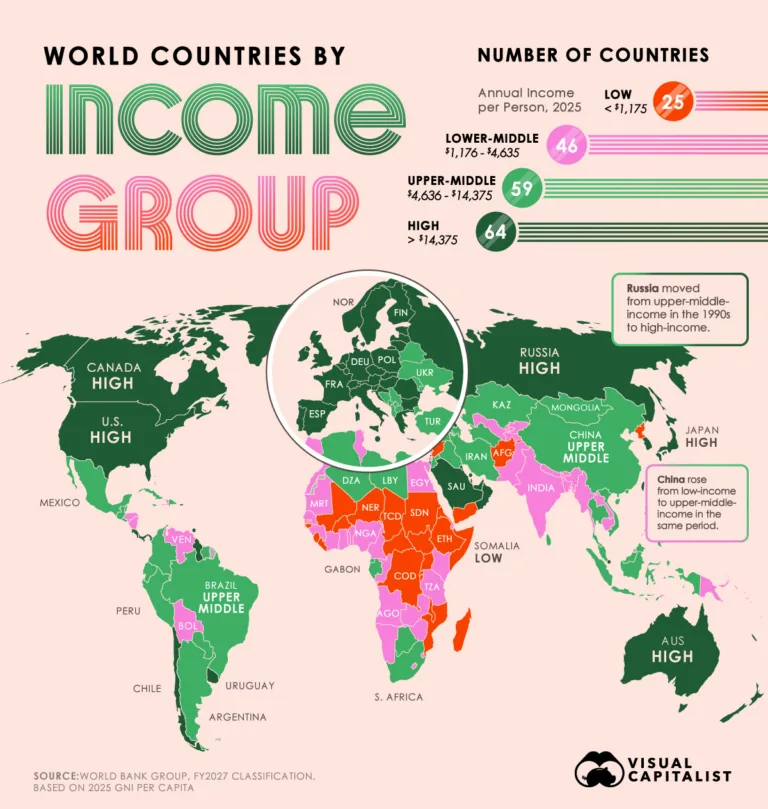
Annual updates to the World Bank income groups dataset provide critical insights into global economic development, shifting national wealth, and changing living standards. Based on Gross National Income (GNI) per capita measured via the Atlas method, the international financial institution divides 218 reporting economies into four distinct categories. Consequently, tracking these classifications highlights broad structural transitions across emerging and developed markets over recent decades.
Structural Shifts Across Global Regions
Over the past quarter-century, the global distribution of income categories has shifted dramatically toward higher-income brackets. Specifically, low-income nations now represent roughly 12 percent of economies worldwide, down from over 30 percent in the late 1980s.
“Long-term economic reforms and industrialization continue to move major developing nations out of low-income categories into middle- and upper-tier brackets,” noted economic researchers.
Furthermore, East Asia and Latin America experienced significant upward mobility, propelled by manufacturing expansion, trade integration, and commodities production.
Emerging Market Trajectories and Strategic Outlook
Major global economies demonstrate varying development trajectories within these classifications. While China, Brazil, Mexico, and Türkiye maintain upper-middle-income status, India and Indonesia continue expanding within lower-middle-income tiers.
Therefore, analyzing GNI per capita metrics helps international organizations allocate development aid, determine preferential trade terms, and evaluate long-term poverty reduction efforts. Moving forward, tracking these structural income shifts remains essential for understanding global market dynamics.
Venditti, B. (2026, July 28). Mapped: Every country in the world by income group. Visual Capitalist.https://www.visualcapitalist.com/mapped-every-country-by-income-group/