
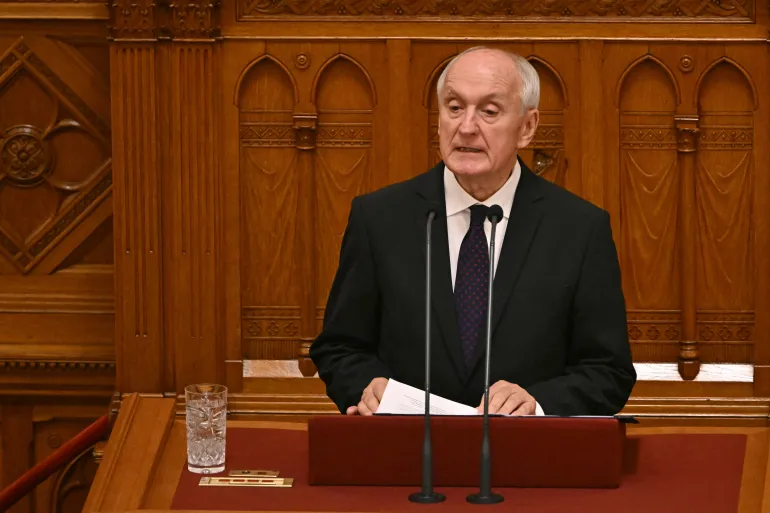
The Hungarian Parliament elected András Baka as the country ‘s new president, with 140 votes in favor and six against. His election is particularly significant because of his previous position as president of the Supreme Court and his criticism of Viktor Orbán’s government. Baka was removed from his judicial position in 2011 after challenging reforms promoted by Orbán ‘s government, arguing that they threatened judicial independence. His return to a prominent state position therefore represents a symbolic departure from the political model developed during Orban´s years in power.
Tisza’s Majority and the Reconstruction of Hungary’s Institutions
Baka´s election was supported by the Tisza Party, which currently holds a constitutional majority of more than two-thirds in Parliament. The party has proposed a significant transformation of the political structures inherited from Orbán, including reforms to the media, the creation of an anti-corruption body, and an eight-year limit on the position of prime minister. From this perspective, Baka´s appointment should not be understood merely as the selection of a new president, but as part of a broader effort to reconstruct Hungary’s political institutions.
Political conflict over Hungary’s future
The election also highlights the intense confrontation between the new government and political forces associated with Orbán. Fidesz, the party that dominated Hungarian politics for years, boycotted the vote and Tisza of using authoritarian methods to reshape the political system. Although Tisza rejects these accusations, the dispute demonstrates that replacing one political model with another does not necessarily guarantee a consensual democratic transition. The challenge for the new authorities will be to demonstrate that institutional reforms are genuinely intended to strengthen democracy rather than simply replace one concentration of power with another .
A symbolic presidency with Democratic Implications
Although the Hungarian presidency is largely ceremonial and provides limited powers to veto or return legislation, Baka’s appointment carries considerable symbolic importance. His election represents the return of a figure who previously raised concerns about threats to judicial independence and who is now occupying a central position within the state. In this sense, the presidential transition can be interpreted as part of a broader attempt by the new authorities to restore the separation of powers and challenge institutional structures established during Obrán’s sixteen years of political influence.
The challenge of building a new political order
András Baka ‘s election reflects a broader transformation of Hungarian politics that goes beyond a change in the presidency. The new government is attempting to dismantle elements of the political system developed during the Orbán era and establish new institutional rules. However, Tisza’s greatest challenge will be ensuring that these reforms permanently strengthen judicial independence, accountability, and the balance of powers. Therefore, Baka’s appointment could represent an opportunity for Hungary to enter a new democratic phase, but it also raises the challenge of ensuring that breaking with the past does not simply result in a new concentration of power under different political leadership.
Referencia:
Al Jazeera. (2026, August 11). Hungary elects Supreme Court judge ousted by Orbán as new president. Al Jazeera.