
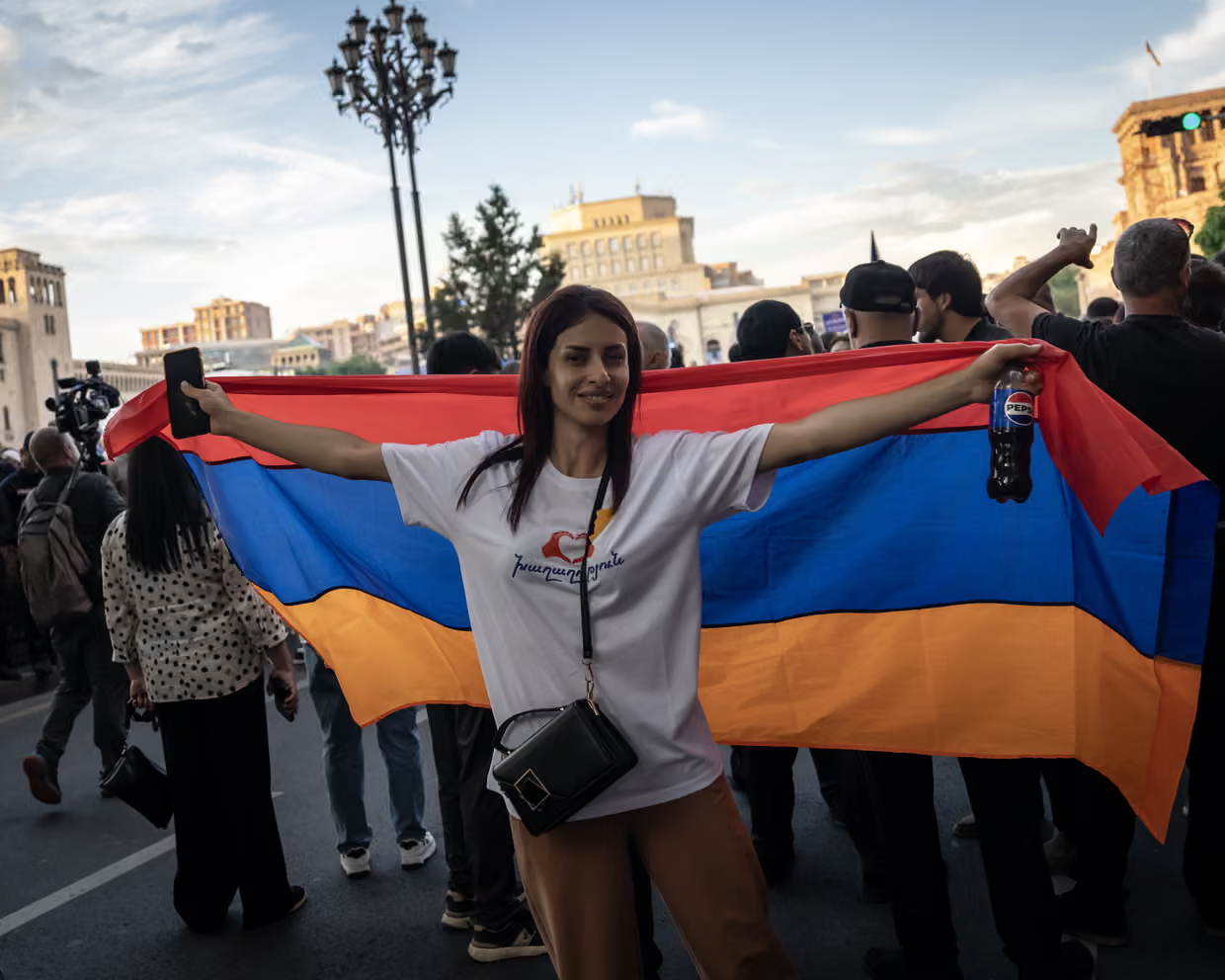
Armenia’s parliamentary election has become a defining moment in the country’s post-Soviet history. What is at stake extends far beyond party politics. Voters are effectively deciding how Armenia should position itself in a rapidly changing geopolitical landscape and whether it should continue moving away from Russia’s sphere of influence after decades of close dependence.
The election unfolds against the backdrop of a profound rupture in Armenian-Russian relations. For many years, Moscow was viewed as Armenia’s principal security partner. That perception weakened dramatically after Azerbaijan regained control of Nagorno-Karabakh in 2023. Many Armenians felt abandoned by an ally that had long portrayed itself as the guarantor of their security. The episode triggered a broader reassessment of the country’s foreign policy and accelerated efforts to diversify diplomatic and economic partnerships.
Prime Minister Nikol Pashinyan has built much of his political strategy around this shift. His government has pursued closer relations with Europe and the United States while promoting a peace agenda with Azerbaijan. Supporters argue that Armenia must adapt to a new regional reality and reduce its reliance on external actors whose commitments have proven uncertain. For them, stability and economic development depend on expanding diplomatic options rather than remaining tied to a single power.
Yet this vision remains deeply contested. Critics accuse the government of weakening Armenia’s negotiating position and making excessive concessions after military defeat. The loss of Nagorno-Karabakh continues to shape public debate, serving as both a symbol of national trauma and a source of political polarization. Opposition forces have sought to channel these frustrations into support for a different path, one that would restore closer ties with Moscow and challenge the government’s current direction.
The campaign has unfolded amid growing tensions with Russia. In recent months, Moscow has imposed restrictions on Armenian exports and issued warnings about the consequences of deeper integration with Western institutions. Such measures have reinforced concerns that economic dependence can be used as a political tool. The pressure has also highlighted a difficult reality for Armenia: despite efforts to diversify its partnerships, important sectors of its economy remain closely linked to Russia.
Adding to the atmosphere of uncertainty are repeated references by Russian officials and commentators to a possible “Ukrainian scenario.” These warnings carry significant symbolic weight in a region already shaped by the consequences of war and geopolitical confrontation. Whether intended as deterrence or political messaging, they have amplified fears about the risks associated with Armenia’s changing foreign-policy orientation.
At its core, the election reflects a broader struggle over sovereignty, security and national identity. Armenia finds itself navigating competing pressures while attempting to redefine its place in a region marked by unresolved conflicts and shifting alliances. The challenge is not simply choosing between East and West, but determining how a small state can preserve its autonomy while managing relationships with far more powerful actors. The outcome will help shape not only the country’s foreign policy but also its understanding of what security and independence mean in an increasingly uncertain international environment.
Reference: Roth, A. (2026, June 6). Armenia heads to polls amid Russian pressure and threat of ‘Ukrainian scenario’. The Guardian. https://www.theguardian.com/world/2026/jun/06/russia-putin-armenia-election