
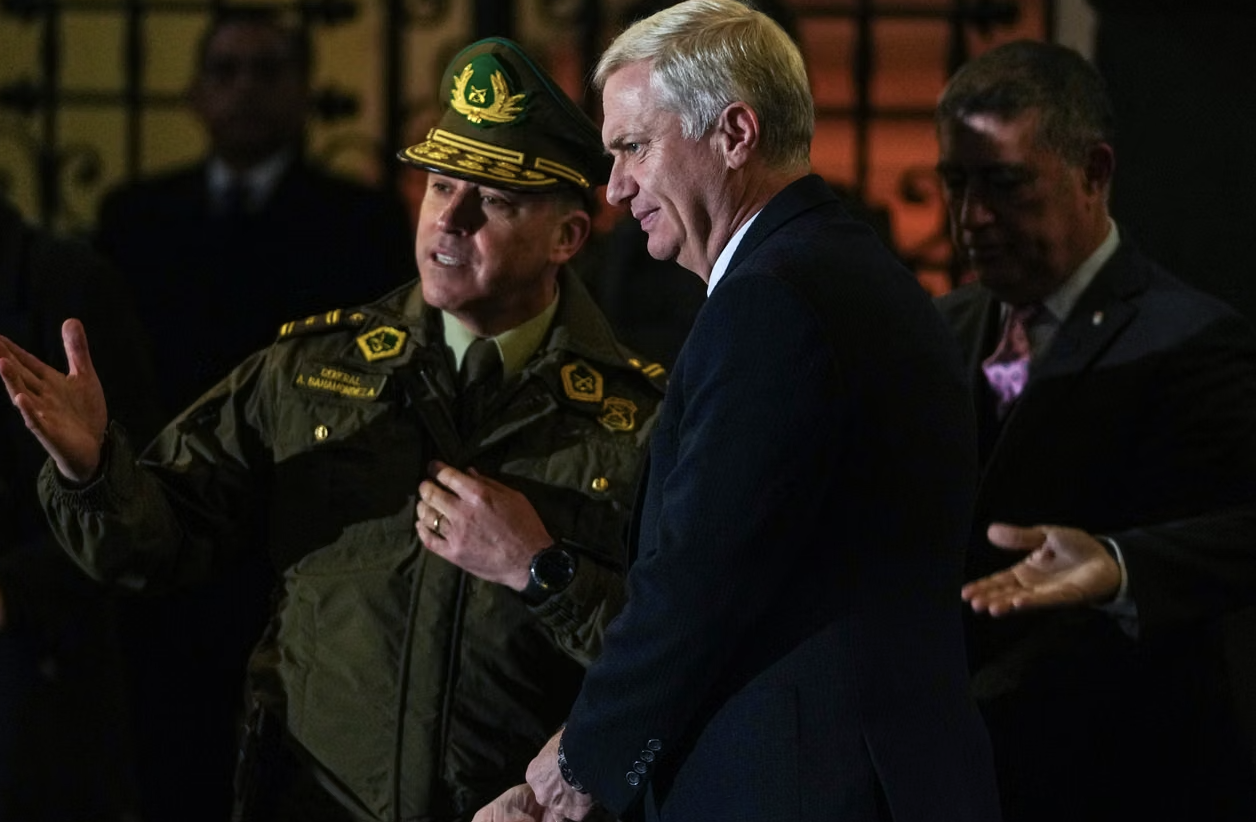
Chilean President José Antonio Kast has presented a constitutional reform project that would allow him to decree a state of exception alone, without Congress approval. The proposal has caused an uproar in Chile. It raises concern both in the opposition and within the president’s own far-right camp.
First of all, the project would allow the president to decree a state of exception for 120 days, renewable, without Congress approval. Many rights, including freedom of movement, assembly, and association, would be suspended. Communications, including those of journalists, could be intercepted. Property could be requisitioned. What is more, the draft text provides for military intervention to ensure public security.
Alongside this, the proposal has been rejected by the three main right-wing parties aligned with Kast’s Republican Party: the Independent Democratic Union, National Renewal, and Political Evolution. The president of the UDI stated that his party “cannot support” these reforms, which “undermine institutions.” One senator called the project “madness.” The president of the Senate asked the government to withdraw its proposal.
The government argues that the state needs more specific tools against organized crime. Security was one of Kast’s two campaign promises, along with the economy. On August 4, he obtained a “megareform” favorable to capital holders and high net worth individuals. The following day, he announced the sending of about thirty security laws to Congress.
However, the proposal has drawn criticism from across the political spectrum. The conservative newspaper La Tercera stated in an editorial that the proposal risks “establishing precedents that could seriously undermine citizens’ guarantees and, therefore, democracy itself.” Similarly, an intellectual reference of the right co-signed an op-ed denouncing a “manifestly illiberal” reform and called for its withdrawal.
According to a Cadem poll, 58 percent of those surveyed believe the government should abandon the project. For economist and politician Carlos Ominami, this project of “constitutional dictatorship” is explained by the “intrinsically illiberal character” of Kast’s government. Ominami fears that a president could decree a state of exception indefinitely under the proposed measures.
In response to the outcry and the prospect of an inevitable defeat in Congress, the government has said it is open to modifications. Nevertheless, it has so far refused to withdraw the text. The president of the Senate Constitution Commission announced that debates would not begin as scheduled and could be postponed until October.
Reference
Le Monde, “Au Chili, un projet de réforme constitutionnelle du président José Antonio Kast jugée ‘illibérale’ par tout l’arc politique,” published August 29, 2026. https://www.lemonde.fr/international/article/2026/08/29/au-chili-un-projet-de-reforme-constitutionnelle-du-president-jose-antonio-kast-jugee-illiberale-par-tout-l-arc-politique_6760021_3210.html