
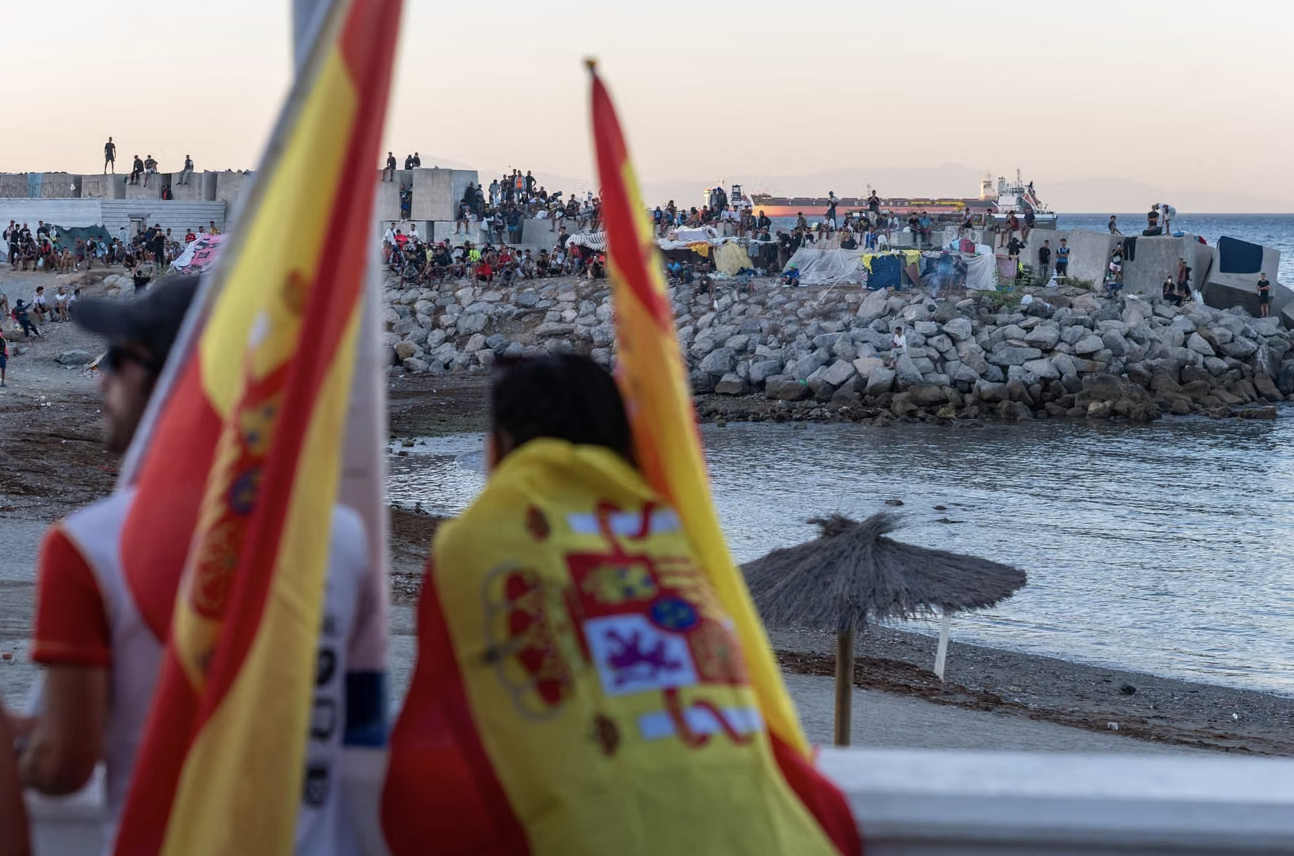
Nearly a month has passed since mass crossings into Ceuta. This city is a Spanish territory in North Africa. On July 30 and 31, more than 70,000 people from Morocco entered the area. Several thousand are still there today.
A fierce information battle is now being fought. Media in both Spain and Morocco are involved. As a result, the two countries have been pushed back into a crisis. However, neither side calls it that openly.
The tension resurfaced on August 24. A religious ceremony took place that day in Rabat. During the event, Morocco’s minister gave a speech. He mentioned a “sacred struggle.” He also called Ceuta and Melilla “occupied cities.” These words caused outrage in Spain.
Many Spaniards still suspect Morocco helped organize the crossings. In their view, the goal was to pressure Spain. For its part, the Spanish government denies this. Nevertheless, no clear evidence has been shown yet.
Morocco’s justice minister has often spoken about his country’s “historical rights” over the enclaves.
An information war has also erupted between the media. Spanish newspapers say Ceuta and Melilla were Spanish before Morocco existed. Meanwhile, Moroccan media question Spain’s right to be there. Interestingly, the UN does not consider these places as territories to be decolonized.
Some writers have sided with Morocco. For example, Boualem Sansal argues that European borders should stay in Europe. He says Ceuta and Melilla are on African land. Similarly, historian Bernard Lugan agrees.
This media battle has sparked controversy. A 28‑year‑old woman swam to Ceuta. She told a Spanish newspaper she left Morocco because women are treated badly. She also said her family stopped her from traveling.
However, Moroccan internet users found photos of her online. The pictures showed her in Qatar, Dubai, and Turkey. This does not prove her life in Morocco was easy. Despite this, it does make her story less believable.
The split between the two countries has grown. Hackers released the names of thousands of Moroccans who work in security. In response, Spain’s far‑right party Vox wants them expelled.
People also remember the Perejil Island dispute from 2002. That was a time of frozen relations.
Spain’s foreign minister spoke on August 28. He said communication with Morocco continues. He called cooperation “essential.” In addition, he stated that Spain’s sovereignty over Ceuta and Melilla is not up for debate.
Oddly enough, this crisis has united two rival Spanish parties. Vox and the left‑wing Sumar party usually disagree. However, both want Morocco excluded from the 2030 World Cup. That event is set to be hosted by Morocco, Spain, and Portugal together.
Reference
Le Monde, “Entre le Maroc et l’Espagne, la crise de Ceuta ressuscite le contentieux frontalier,” published August 29, 2026. https://www.lemonde.fr/afrique/article/2026/08/29/entre-le-maroc-et-l-espagne-la-crise-de-ceuta-ressuscite-le-contentieux-frontalier_6759747_3212.html