
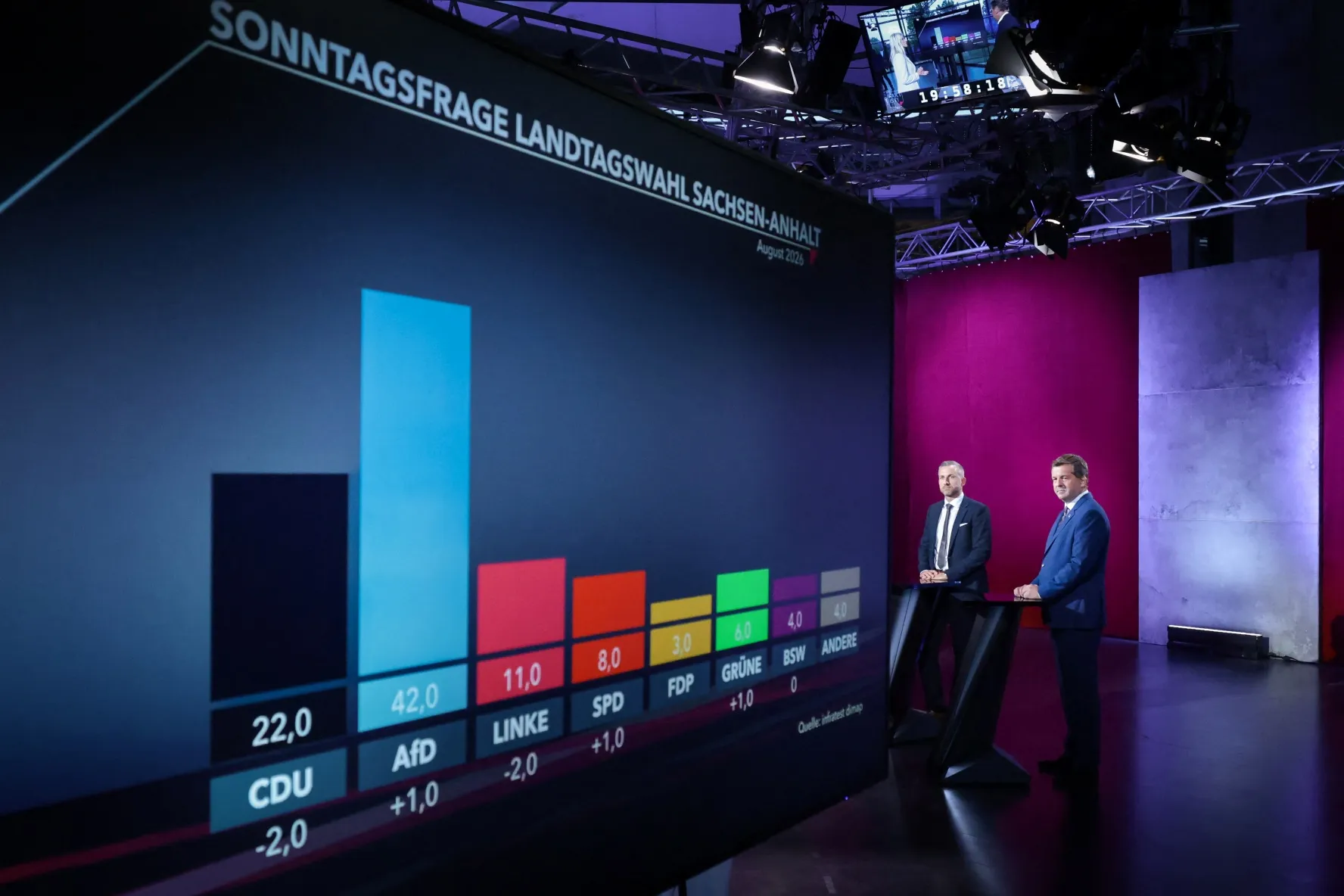
The Alternative for Germany (AfD) stands on the brink of a historical breakthrough in Saxony-Anhalt. Specifically, polling data places the far-right party at 41% ahead of the September election. Consequently, the party could secure an absolute majority in a state legislature for the first time. However, state intelligence services officially classify the regional chapter as a confirmed extremist organization. Furthermore, researchers point to the party’s explicitly anti-democratic and radical rhetoric.
The AfD has published a comprehensive 258-page governing platform. Specifically, this manifesto includes proposals to deport refugees, defund public broadcasting, and roll back LGBTQ+ rights. Furthermore, independent economic analyses show that implementing this platform would create massive budgetary deficits. Legal experts also warn that several core proposals violate the German Basic Law. In addition, analysts question whether the party possesses enough qualified personnel to fill key administrative roles.
Traditional political parties face severe dilemmas regarding governance strategy. Specifically, mainstream parties maintain a formal firewall to exclude the AfD from potential coalitions. However, forming a stable anti-AfD coalition requires deeply divided parties to cooperate. Consequently, prolonged political instability could weaken institutional efficiency in the state. Furthermore, legal scholars are actively analyzing constitutional mechanisms to protect democratic institutions from potential subversion.
The regional election carries profound consequences for the national political landscape in Berlin. Specifically, a strong performance by the AfD could undermine the national coalition government led by Chancellor Friedrich Merz. Furthermore, national AfD leaders view Saxony-Anhalt as a strategic laboratory for national power. As a result, increasing political fragmentation may leave Germany more inward-focused and less capable of decisive international leadership.
Reference
Silbiger, M., & Stelzenmüller, C. (2026, September 4). Could the right-wing extremist AfD govern a German state for the first time? Brookings Institution. https://www.brookings.edu/articles/could-the-right-wing-extremist-afd-govern-a-german-state-for-the-first-time/