
The Transition from Maritime Harassment to “Ecological Siege”
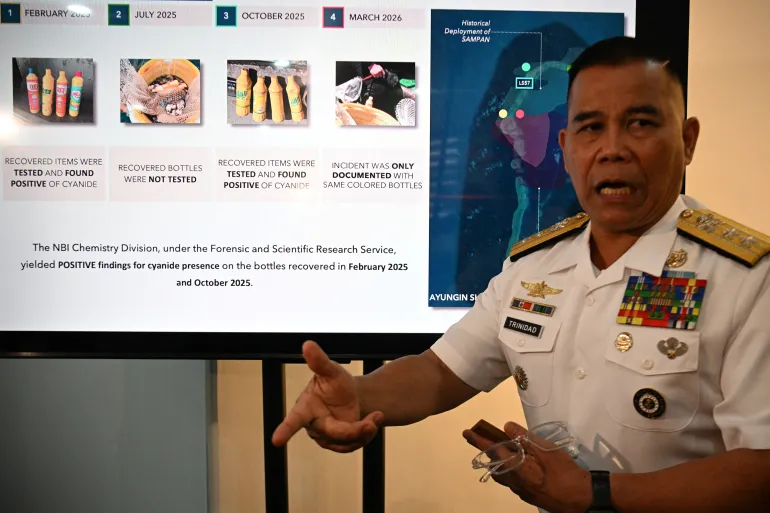
By April 2026, the long-standing dispute over the Second Thomas Shoal (Ayungin Shoal) has transitioned from water cannon confrontations to accusations of systemic poisoning. The Philippine National Security Council (NSC) has formally accused Chinese fishermen, supported by the China Coast Guard, of pouring cyanide into the waters surrounding the atoll. Consequently, the conflict is being reframed from a purely legal or military dispute to one of “environmental sabotage.” This suggests that Beijing may be attempting to make the reef uninhabitable for the Filipino marines stationed there by destroying the local ecosystem that serves as a vital food source.
Origins and the “Sierra Madre” Structural Threat
Originally, the primary concern at the shoal was the physical resupply of the BRP Sierra Madre, the grounded World War II-era vessel that serves as Manila’s sovereign outpost.However, the origin of this current crisis lies in findings from laboratory tests on water samples and materials seized during naval operations throughout 2025 and early 2026. For 2026, the Philippines alleges that the cyanide is intended to not only kill fish populations but also to weaken the coral reef structure beneath the warship, potentially compromising its physical stability. Furthermore, the report emphasizes that this follows a series of violent incidents in late 2025, suggesting a shift toward “asymmetric” methods of eviction.
The Structure of “Plausible Deniability” and Strategic Denial
The structure of this alleged poisoning operation is organized around the use of Maritime Militia—fishing vessels that operate under the protection of the state but maintain a civilian facade. Specifically:
- Targeted Poisoning: The use of cyanide “bottles” to clear fish stocks, which Manila argues is a dual-purpose tactic for both economic gain and strategic harassment.
- Logistical Deprivation: By poisoning the local waters, the Chinese forces aim to force the Filipino troops into total dependence on external resupply missions, which are frequently blocked by the Chinese Coast Guard.
- Institutional Friction: The article highlights the tension within ASEAN, where member states are wary of criticizing China’s environmental record despite the clear violation of international maritime laws regarding reef preservation.
Synthesis of Environmental Security and the “Lawfare” Counter-Offensive
The successful exposure of these cyanide tactics now faces a paradox where Environmental Data is being used as a tool of “Lawfare.” This represents a new front in International Relations where environmental protection is no longer a secondary concern but a primary justification for sovereign defense. There is a clear intent in Manila to bring these findings before an international tribunal to reinforce the 2016 Arbitral Ruling that China’s activities have caused “irreparable harm” to the marine environment. Ultimately, it is clear that if the cyanide allegations are proven, it will set a dangerous precedent for the use of “silent” biological or chemical agents in maritime territorial disputes, turning the “blue economy” into a poisoned battlefield.
Reference
Al Jazeera. (2026, April 13). Philippines accuses China of using cyanide to poison South China Sea atoll. Al Jazeera News Asia Pacific. https://www.aljazeera.com/news/2026/4/13/philippines-accuses-china-of-using-cyanide-to-poison-south-china-sea-atoll