
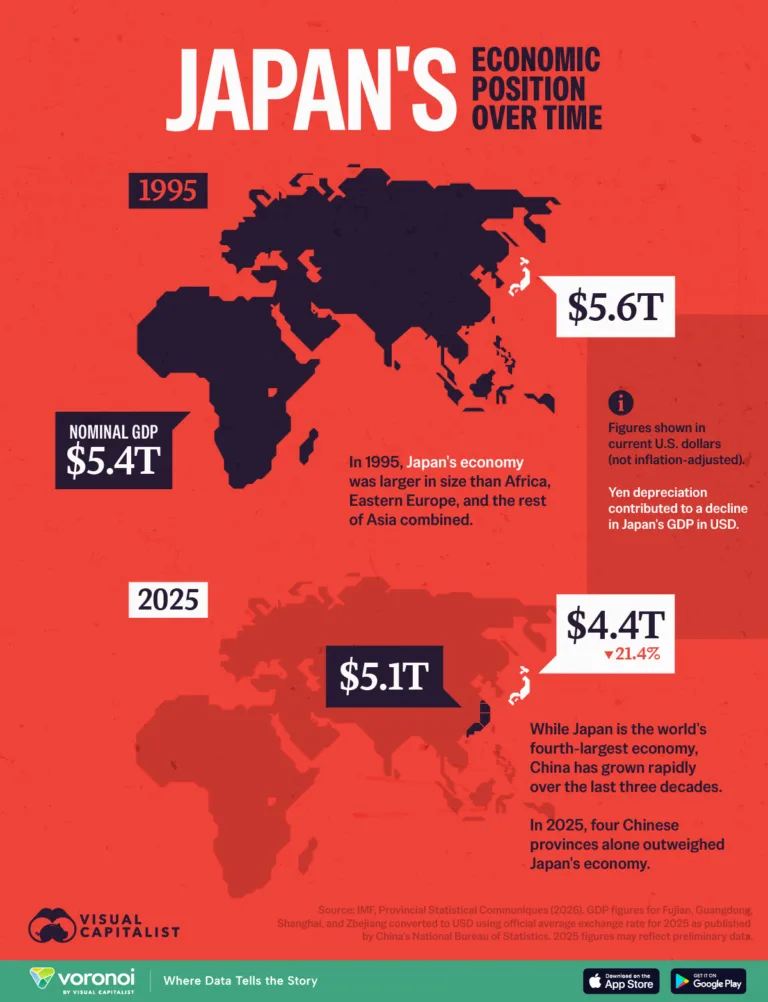
The late 20th century was defined by an unprecedented Japanese financial boom that eventually collapsed. According to historical economic records, the stagnation that followed the asset bubble burst fundamentally altered the nation’s trajectory. In fact, it was during these subsequent “lost decades” that Japan lost economic dominance as its GDP growth slowed to a crawl.
Moreover, demographic challenges such as a rapidly aging population and a shrinking workforce severely limited the country’s recovery efforts. Consequently, domestic consumption and innovation faced structural hurdles that were incredibly difficult to overcome. As a result, the nation’s undisputed position as the region’s powerhouse began to erode.
The rapid rise of regional rivals
On the other hand, while Tokyo faced internal struggles, neighboring nations began executing aggressive modernization strategies. For example, China’s integration into the global trade system allowed it to achieve double-digit growth rates for years. Furthermore, the realization that Japan lost economic dominance became undeniable when China officially surpassed it as the world’s second-largest economy.
First of all, other nations like South Korea and India also emerged as major industrial and technological competitors. Secondly, these countries leveraged younger demographics and massive foreign investments to build their own industrial empires.
What to expect for future Asian markets?
Additionally, the current economic landscape requires a more nuanced understanding of regional interdependence. Surprisingly, despite the fact that Japan lost economic dominance, it remains a crucial global investor and a leader in high-tech manufacturing today.
Conversely, the national focus has now shifted from undisputed leadership to strategic partnerships and specialized technological exports. For instance, Japanese firms continue to dominate in robotics, automotive innovation, and precision engineering. In conclusion, exploring how Japan lost economic dominance provides vital lessons for modern economies facing similar demographic and structural challenges in 2026.
Reference: Visual Capitalist. (2026). How Japan lost its economic dominance in Asia. https://www.visualcapitalist.com/japan-lost-its-economic-dominance-in-asia/