
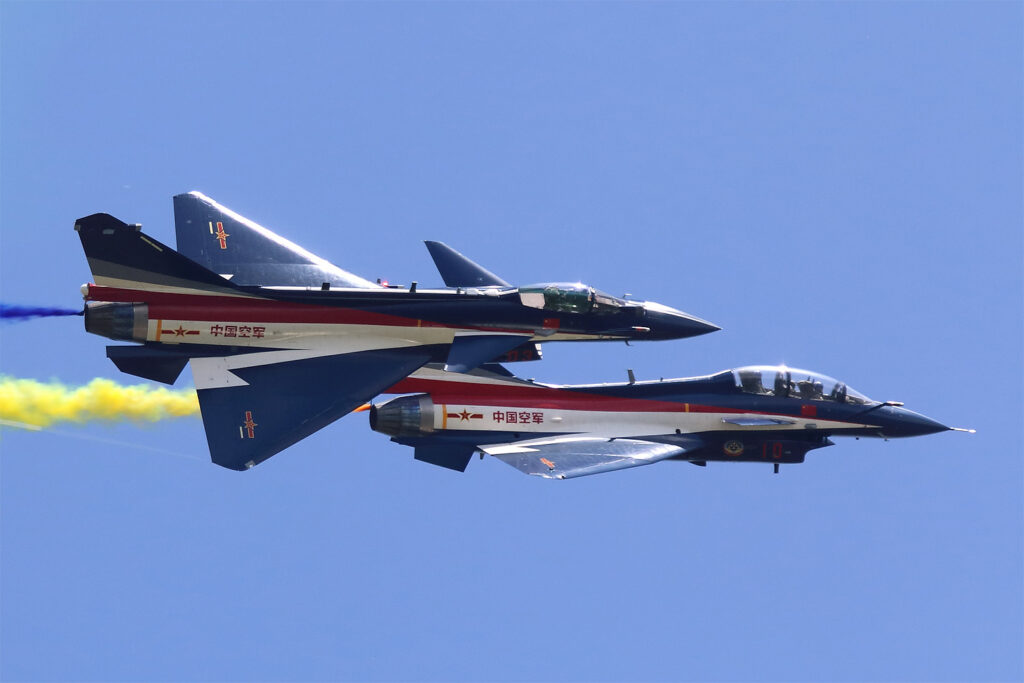
Indonesia’s recent announcement of its intention to purchase 42 Chinese J-10 fighter jets has sparked debate about the country’s defense strategy and geopolitical motives. The move comes after similar commitments to buy aircraft from South Korea (KF-21 Boramae), Turkey (TAI Kaan), and France (Dassault Rafale). As well as expressions of interest in the U.S. F-15EX Eagle II. Currently, Indonesia’s Air Force already operates a diverse fleet, including F-16s, Su-27/30s, T-50s, and BAE Hawks, raising concerns about the practicality of adding yet another system to an already complex inventory.
According to experts, the decision seems less about operational needs and more about geopolitical maneuvering. Euan Graham from the Australian Strategic Policy Institute argues that President Prabowo Subianto appears to be pursuing “poly-alignment” . In other words, balancing relations with multiple powers while seeking the best deals. Playing the “China card,” he notes, could be a negotiation tactic to gain better terms from Western suppliers.
Similarly, Collin Koh from Singapore’s S. Rajaratnam School of International Studies suggests the move reflects Indonesia’s desire to strengthen ties with China for economic and political reasons. The economy is still maintaining its policy of diversifying arms suppliers after past U.S. embargoes. He highlights that Indonesia has missed its 2024 defense targets, such as reaching ten combat squadrons and a 274-ship navy, largely due to chronic underfunding.
Final thoughts
Both analysts agree that maintaining such a diverse fleet will be logistically and financially burdensome, given Indonesia’s limited defense budget and history of underinvestment. Koh warns that much of Indonesia’s military hardware is obsolete or nearing obsolescence, requiring massive but poorly coordinated modernization spending.
Graham further cautions that buying from China carries strategic risks. It creates a long-term dependency on Beijing and could imply that Indonesia would never engage in conflict with China. A notion that might unsettle parts of the Indonesian military. In the end, both experts see Indonesia’s arms purchases as a reflection of short-term pragmatism and diplomatic balancing rather than a coherent long-term defense strategy.
Reference
Yeo, M.(2025, October 27). Indonesia’s J-10 fighter buy from China a geopolitical play with capability risks: Experts. Breaking Defense. https://breakingdefense.com/2025/10/indonesias-j-10-fighter-buy-from-china-a-geopolitical-play-with-capability-risks-experts/