
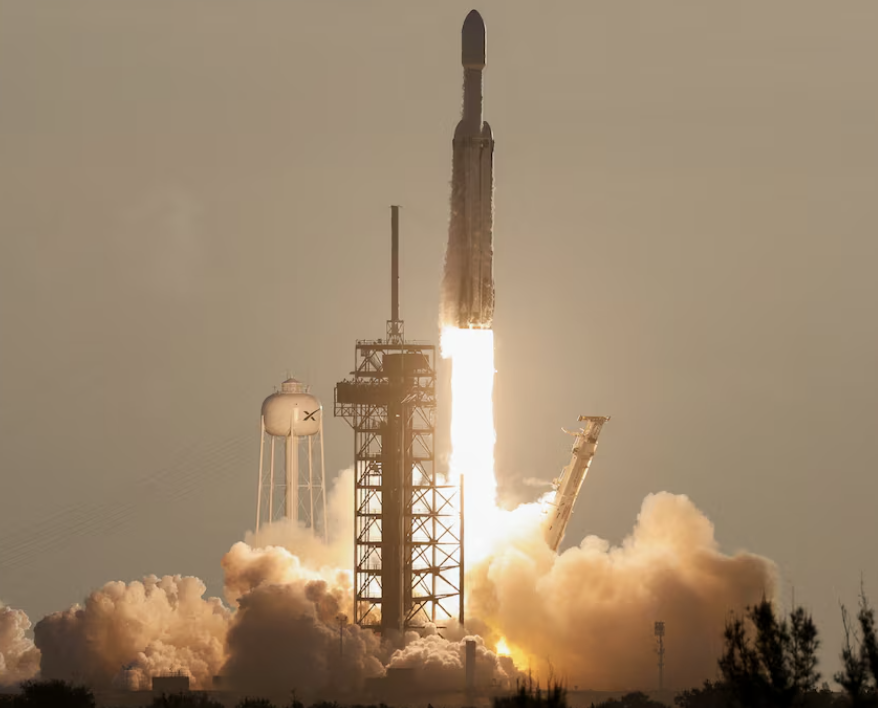
NASA launched its new flagship observatory on Sunday, August 30. The Nancy Grace Roman Space Telescope lifted off from Florida’s Kennedy Space Center. A SpaceX Falcon Heavy rocket carried it just after sunrise. The mission is planned for five years. NASA said it may have enough fuel for five more.
The telescope was originally built for a spy satellite program. That program was over budget and cancelled. The NRO donated it to NASA in 2012. NASA repurposed it for space exploration. Roman will travel to Lagrange Point 2, about a million miles from Earth.
The telescope will study dark energy, dark matter, and exoplanets. Senior scientist Julie McEnery said: “It feels like I’m on the edge of a precipice.” Scientists will spend 90 days commissioning it. Roman is expected to send back its first high-resolution images before winter.
Roman builds on Hubble and Webb’s work. NASA Administrator Jared Isaacman said: “Roman will become a household name alongside those great instruments.” Roman has the same sharpness as Hubble but surveys much faster. It can map the entire Milky Way in a month. Hubble would need a century.
Roman will create the most detailed 3D map of the universe. Its main survey will cover over two billion galaxies. The universe is about 5 percent ordinary matter, 27 percent dark matter, and 68 percent dark energy. Roman will also search for exoplanets. It is expected to discover thousands of new ones.
President Trump called NASA to congratulate them. He said the launch “looked beautiful on television.” His administration had tried to cancel Roman twice. But Congress preserved it. The launch came nine months ahead of schedule.
Reference
Reuters, “NASA launches powerful new Roman Space Telescope, a spy satellite turned to the stars,” published August 30, 2026. https://www.reuters.com/science/nasa-launches-powerful-new-roman-space-telescope-florida-2026-08-30/