
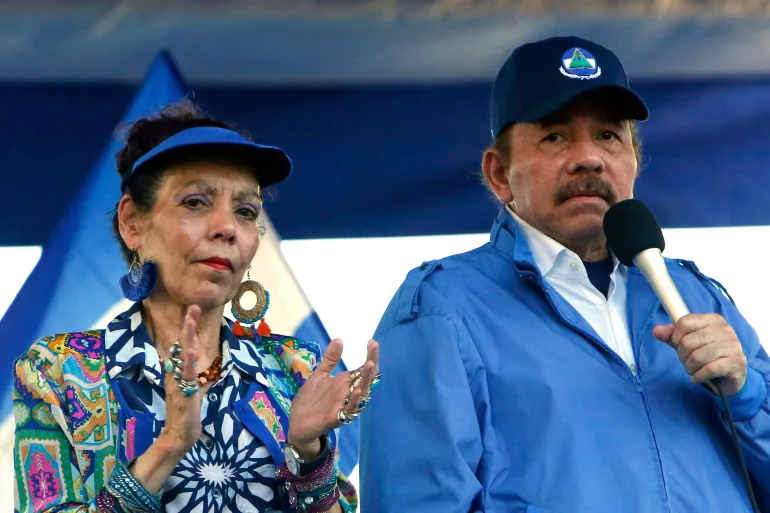
Nicaragua is facing a new political crisis as the Organization of American States (OAS) prepares to hold an emergency meeting of foreign ministers to discuss the country’s democratic situation. On August 19, 2026, the OAS Permanent Council approved the resolution by a vote of 29 to 1, with one abstention and two countries absent. This decision reflects growing international concern over the actions of President Daniel Ortega and Co-President Rosario Murillo, especially a series of constitutional reforms that could further weaken democratic institutions and political competition.
One of the most controversial proposals is the extension of the presidential term from six to seven years. In addition, the reforms would allow authorities to prevent opposition candidates from running for office if they are classified as “traitors of the homeland.” Electoral authorities would also gain the power to dissolve political parties that receive foreign funding. As a result, many observers fear that future elections may no longer provide genuine political competition. Since the Nicaraguan legislature is expected to vote on these reforms in September, the OAS decision comes at a critical moment.
The Erosion of Political Pluralism
The current situation is not an isolated political dispute. Instead, it is part of a broader process of democratic erosion that has developed over several years. Ortega returned to power in 2007 after previously governing Nicaragua from 1979 to 1990. Since then, his administration has faced increasing criticism for weakening institutional checks and limiting the role of opposition parties.
The political environment became even more restrictive after the large-scale protests of 2018. Following those demonstrations, the government intensified pressure on opposition groups, independent media outlets, and civil society organizations. Consequently, political dissent has become increasingly difficult to express.
From an international relations perspective, Nicaragua illustrates how democratic institutions can gradually weaken through legal and constitutional reforms. Rather than eliminating elections entirely, governments may modify electoral rules, restrict political competitors, and reduce institutional independence. Over time, these changes can make meaningful political competition increasingly difficult. Therefore, Nicaragua represents an important case study for understanding democratic backsliding in Latin America.
The Limits of Regional Pressure
The OAS resolution is significant because it demonstrates a collective regional response to concerns about democracy and human rights. The organization invoked Articles 61, 62, and 63 of the OAS Charter, which are among its strongest mechanisms for addressing urgent situations that affect member states. However, the effectiveness of this response remains uncertain.
A major challenge is that Nicaragua formally withdrew from the OAS in 2023 after initiating the process in 2021. As a result, the organization has limited direct influence over the country’s internal affairs. This creates a clear contradiction: the OAS is attempting to address developments in a state that is no longer part of the institution.
Nevertheless, the overwhelming vote in favor of the resolution carries important diplomatic weight. It signals that a large majority of governments in the Americas are concerned about Nicaragua’s political trajectory. Even if enforcement mechanisms are limited, the decision sends a strong message regarding regional democratic norms.
Regional Implications
The crisis in Nicaragua has consequences that extend beyond its national borders. Continued restrictions on political participation and civil liberties may contribute to migration flows, diplomatic tensions, and regional instability in Central America. Furthermore, the United Nations has warned that limiting meaningful electoral competition could further undermine the rule of law. UN officials have also expressed concern about severe restrictions on fundamental freedoms under the Ortega-Murillo administration.
Ultimately, the OAS decision represents an important diplomatic warning. However, its long-term impact will depend on whether regional governments can transform political condemnation into meaningful action. Nicaragua’s withdrawal from the organization limits the OAS’s ability to exert direct pressure, while the proposed constitutional reforms suggest that the country’s political system continues to move away from democratic standards.
For this reason, the emergency meeting should be viewed as more than a routine diplomatic event. It represents a broader test of how effectively regional institutions can respond to democratic backsliding in Latin America. The outcome may shape not only Nicaragua’s future but also the credibility of regional organizations committed to defending democratic governance.
Reference:
Bah, M., & Anadolu. (2026, August 19). International body votes to convene emergency meeting over Nicaragua. Al Jazeera. https://www.aljazeera.com/news/2026/8/19/international-body-votes-to-convene-emergency-meeting-over-nicaragua