
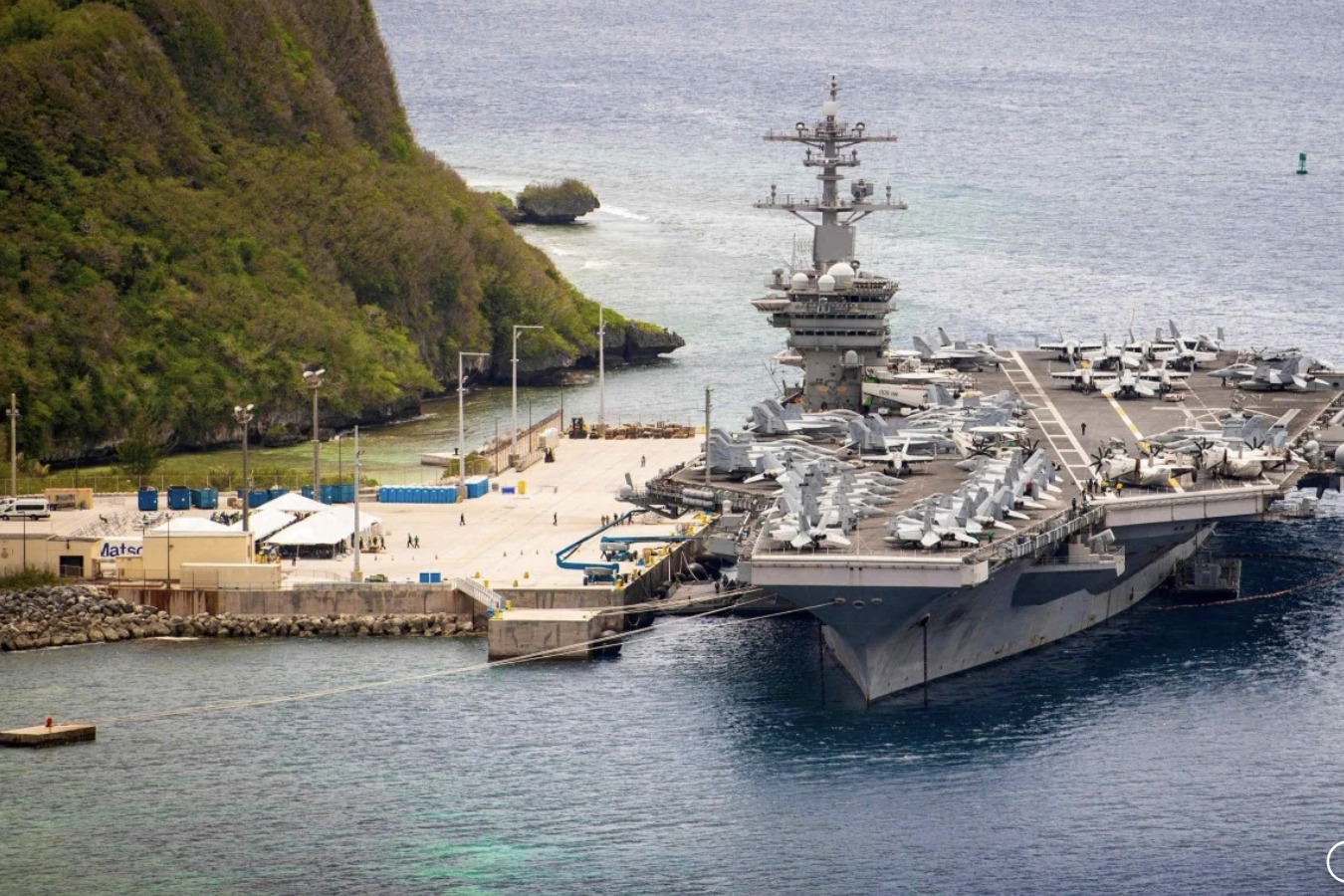
The United States quietly pulls its most precious military assets away from the coasts of Asia. Consequently, they are falling back to places like Guam in Micronesia, a US island territory far beyond the reach of most conventional missiles. This distance can become a shield and dispersion a weapon in modern warfare. A team of Chinese defence scientists has been solving this puzzle. They openly published a step-by-step guide on how to destroy a US carrier group from 3,000km away. This is precisely the distance from Shanghai to Guam.
Distributed Maritime Operations
For years, the US Navy operated big ships relatively close to China. This proximity made them vulnerable to China’s growing arsenal of anti-access and area-denial weapons. To counter this, the Pentagon adopted a new concept called Distributed Maritime Operations. Instead of clustering a strike group inside one small patch of ocean, this strategy scatters the ships over hundreds of kilometres. The US fleet pushes the most valuable carriers further back. Simultaneously, it sends smaller, more expendable vessels forward to act as missile shields and floating radars.
The Chinese Swarm Strategy
The Chinese researchers’ plan begins with a surprise. Instead of launching a mass wave of missiles from land or the air, they propose using a submarine to fire hypersonic anti-ship missiles at the forward Aegis destroyers. By striking the outer layer first, the PLA can punch a hole through the midcourse missile defence shield. Once that shield is cracked, the carrier becomes much more exposed to follow-up salvos.
After the opening punch, the plan calls in an orchestrated firepower package. This mixes cheap decoy drones, low-cost cruise missiles, subsonic stealth cruise missiles, and more hypersonic missiles. This combination puts the US defences in a no-win dilemma. If they shoot at the decoys and cheap missiles, they burn through their limited ammunition. Alternatively, if they focus on the hypersonic threats, the stealthy low-fliers might sneak through.
Unprecedented Tactics and Production Capacity
One of the most unusual elements in the paper is a tactic called leader-follower mode. In a missile swarm, one missile climbs high and acts as a scout. This leader scans the battlefield and relays targeting data to the other missiles flying low under the radar horizon. If the leader is shot down, another immediately takes its place. Therefore, the swarm does not need constant instructions from a distant command centre.
Finally, the authors argue that America’s deindustrialisation and shrinking ability to control far-flung bases are the real drivers of the DMO concept. The US can no longer afford to keep its carriers parked in harm’s way. On the other hand, China’s shipbuilding capacity dwarfs that of the United States. Furthermore, Chinese missile production lines can churn out weapons at a pace that makes mass-swarm tactics feasible.
Reference
Chen, S., & Chen, S. (2026, 12 junio). PLA scientists propose a plan to destroy US carrier groups from 3,000km away. South China Morning Post. https://www.scmp.com/news/china/science/article/3355897/pla-scientists-propose-plan-destroy-us-carrier-groups-3000km-away?share=dYm066KRAPGJREbHoVyPvrwZoANaQtg43ad8PZbC8GQ4VwbINh8nqSNTNSEri9Oq6F7wFhPZMbrHIED3Eiqpy9EvPLeJn6S9oki0YYCqOzk%3D&utm_campaign=social_share