
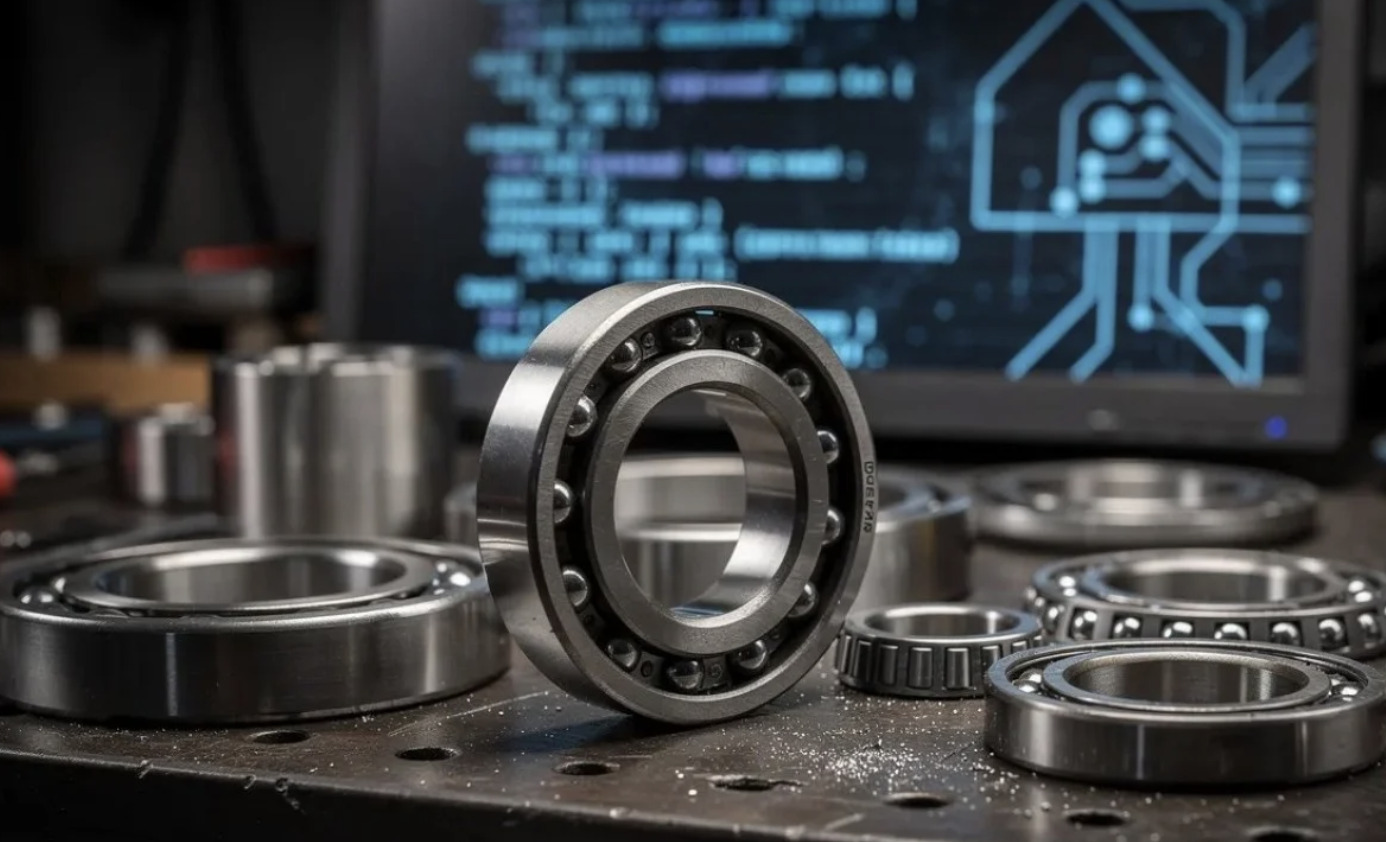
While much of military AI globally focuses on autonomous weapons and large language models, Beijing is pursuing a quieter transformation. A new study suggests China is embedding artificial intelligence in the deepest layers of industrial manufacturing. Specifically, researchers developed an AI-powered bearing design agent capable of autonomously designing rolling bearings in advanced machinery. This study was published in the Chinese defence engineering journal Acta Armamentarii, a leading platform for the country’s weapons industry.
The ChatBearing System
The researchers from Chongqing University detailed an AI system called ChatBearing. This system successfully combines large language models with engineering calculation tools and industrial databases. Consequently, it can autonomously perform design requirement analysis, load calculation, bearing selection, and life prediction. Previously, traditional bearing design relied heavily on experienced engineers, lengthy trial-and-error processes, and expensive testing under extreme conditions.
In contrast, ChatBearing drastically reduces design time from several hours to under three minutes while simultaneously reducing total bearing weight. The system was tested on helicopter tail rotor gearboxes, wind turbine gearboxes, and electric vehicle drivetrains. Ultimately, this AI integrates reasoning models, simulation tools, and a massive database of thousands of bearing records to plan tasks and self-correct errors during the design process.
AI Plus Manufacturing Strategy
In the United States, defence AI discussions largely center on battlefield applications like autonomous drones and AI-assisted command systems. Meanwhile, China may be developing a parallel strategy focused on using AI to strengthen industrial engineering and production efficiency. This distinction is critical because military power depends on the ability to design, manufacture, and sustain advanced weapons at scale. Furthermore, the ongoing Ukraine war has reinforced that industrial endurance matters greatly in modern conflicts.
China already possesses the world’s largest manufacturing base and vast pools of engineering talent. Therefore, AI could amplify these advantages by accelerating prototype development and reducing engineering costs. Even though bearings are fundamental components, they represent foundational manufacturing capability for tanks, missiles, naval propulsion systems, radars, and drones.
Structural and Security Challenges
Despite these impressive advancements, formidable structural challenges remain for China’s AI-assisted military engineering. Current large language model systems are largely unable to enter sensitive weapons development environments. China’s defence system operates as a closed, classified environment physically isolated from the public internet. Therefore, to truly enable AI-assisted military design, the country must construct an entirely separate and secure classified AI infrastructure. Consequently, many current AI experiments in defence-related engineering remain exploratory and limited to non-sensitive research environments.
Reference
Kong, C., & Kong, C. (2026, 27 mayo). AI is massively increasing China’s new weapon development speed: scientists. South China Morning Post. https://www.scmp.com/news/china/science/article/3354989/ai-massively-increasing-chinas-new-weapon-development-speed-scientists?share=VN%2FhmP4eKf4S68Qv0cvw05RrwNieGgXyksngUo9y%2FDi5vemv%2Bx1wLOSbC6Eqn1aUt6DY05vDfChh7Mez%2BGc66xolLuhb8sPPmfC1vYZg2ZM%3D&utm_campaign=social_share