
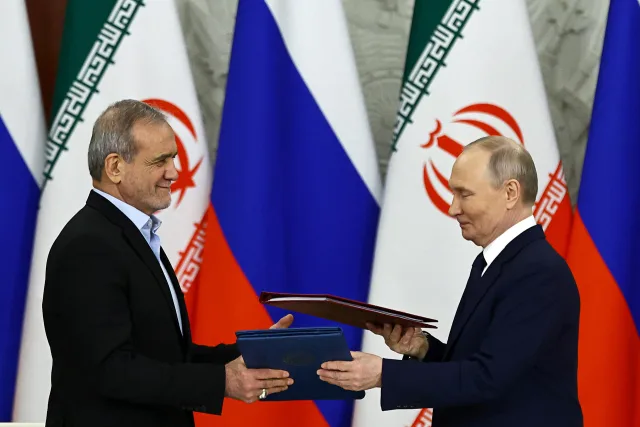
Council on Foreign Relations. The Iran War Is Highlighting—and Expanding—Authoritarian Collaboration
The Iran war has brought renewed attention to the rise of authoritarian collaboration among global powers. This trend reflects increasing coordination between autocratic regimes seeking to strengthen their political survival and reshape the international order. The conflict illustrates how these alliances operate in practice, particularly through military, economic, and technological support.
Authoritarian Collaboration and Support for Iran
Authoritarian collaboration has played a central role in sustaining Iran during the war. Countries such as China and Russia have provided critical assistance, including advanced military technologies, intelligence support, and economic lifelines. China has supplied radar systems, satellite navigation, and continued oil purchases, helping Iran bypass sanctions through complex shipping networks.
At the same time, Russia has contributed drones, cyberwarfare expertise, and targeting assistance. These capabilities have significantly enhanced Iran’s military effectiveness, complicating U.S. operations despite its technological advantages. This cooperation demonstrates how authoritarian regimes increasingly share resources to offset Western pressure.
Expansion of Global Authoritarian Networks
The Iran war highlights a broader expansion of authoritarian collaboration beyond ad hoc cooperation. Over the past decade, autocratic states have formalized partnerships through defense agreements, economic ties, and diplomatic coordination. Examples include the “no limits” partnership between China and Russia and defense agreements linking Russia with countries such as Mali and Niger.
This network is extensive. While some states maintain limited engagement, most authoritarian regimes participate in varying degrees. According to recent research, tens of thousands of interactions among autocracies have been documented, indicating a structured and growing system of cooperation. These regimes now represent a significant share of global population and economic output, increasing their capacity to act collectively.
Strategic Goals and Economic Implications
Authoritarian collaboration is driven by shared strategic objectives. These include preserving regime stability, weakening democratic influence, and building alternatives to the post-World War II international system. Economic coordination is particularly important, especially efforts to reduce reliance on the U.S. dollar.
During the war, Iran leveraged control over the Strait of Hormuz to promote transactions in Chinese yuan, reinforcing ongoing efforts by China and Russia to bypass global financial systems such as SWIFT. This shift has encouraged even U.S. allies in Asia to engage more closely with authoritarian states for energy access, gradually reshaping global financial dynamics.
Impact on Global Order and Democratic Alliances
The Iran war may also weaken cooperation among democracies. Strains between allies and declining global trust in democratic institutions create opportunities for authoritarian states to expand their influence. Research suggests that the share of the global population living in democracies has declined significantly in recent years, reinforcing this shift.
Although authoritarian collaboration has not succeeded in all cases, its growing scale and coordination indicate a durable trend. The war demonstrates how these alliances can sustain regimes under pressure and potentially accelerate the emergence of a more fragmented, multipolar global order.
Reference
Kurlantzick, J. (2026). The Iran War Is Highlighting—and Expanding—Authoritarian Collaboration. Council on Foreign Relations. https://www.cfr.org/articles/the-iran-war-is-highlighting-and-expanding-authoritarian-collaboration