
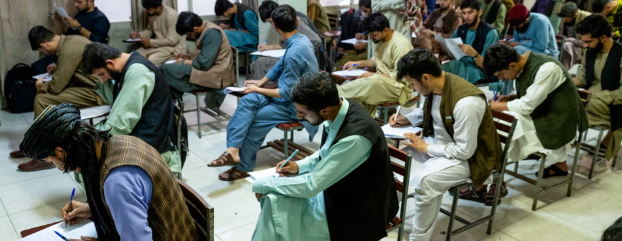
Universities face growing restrictions and loss of academic freedom.
Five years after the Taliban returned to power, Afghan students describe a higher education system increasingly shaped by religious control and strict discipline rather than academic learning. Male students are required to grow beards, wear traditional Afghan clothing, attend mandatory religious lectures, and participate in public prayers, with punishments imposed for minor violations. According to students, these activities often replace regular classes, limiting opportunities for critical thinking and open discussion.
Declining educational quality and shrinking enrollment.
Students interviewed across seven Afghan provinces report that experienced professors have left universities, while many of their replacements lack the qualifications needed to teach. Some newly hired lecturers are recent graduates or even former undergraduate students, resulting in weaker instruction and outdated teaching methods. UNESCO data cited in the report show that male university enrollment fell from 310,369 students in 2019 to 188,957 in 2024, while female enrollment dropped to zero by 2024 following the Taliban’s ban on women attending universities.
Students lose confidence in education and future opportunities.
The report highlights that many young Afghans no longer believe higher education will improve their future. Students argue that universities have shifted away from preparing professionals toward enforcing obedience and ideological conformity. Those studying journalism, in particular, question the value of their education as independent media outlets continue to close and the profession faces increasing restrictions. Many students now attend classes only to meet family expectations rather than out of confidence in their academic future.
A generation at risk of long-term educational decline.
Students and former professors warn that Afghanistan’s universities are losing their ability to produce qualified professionals in fields such as medicine, engineering, journalism, and public administration. The combination of ideological control, declining teaching quality, limited academic freedom, and shrinking enrollment threatens the country’s long-term social and economic development. The report concludes that, although international attention has focused primarily on the exclusion of women, Afghan men also face growing educational restrictions that are reshaping the country’s future.
Reference
Faizi, F. (2026, July 13). The Taliban’s war on education: ‘Nobody talks about what is happening to the boys’. The Guardian. https://www.theguardian.com/global-development/2026/jul/13/afghanistan-education-taliban-universities-teaching-students-religion-women-islam