
The Transition from Full-Scale War to “Spot Hit” Operations
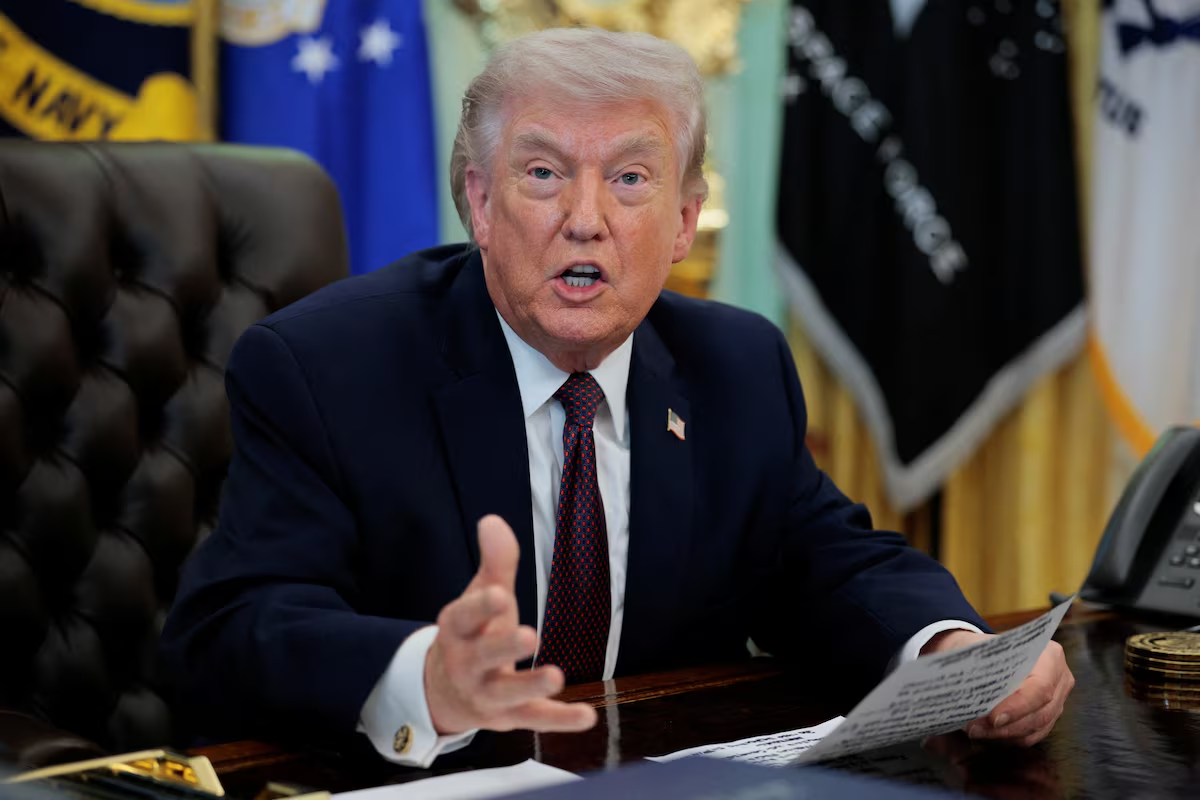
On April 1, 2026, President Donald Trump told Reuters that the United States military will be “out of Iran pretty quickly,” signaling an end to the five-week-old ground and air offensive. Arguing that U.S. strikes have successfully neutralized Tehran’s nuclear capacity, the President stated that the mission has achieved its primary objective of making Iran “incapable” of fielding nuclear arms. Consequently, Washington is pivoting from a doctrine of regime destabilization to one of remote containment, where the U.S. reserves the right to return for “spot hits” if provocations resume. This shift indicates a desire to de-escalate the massive domestic and economic costs of the conflict while maintaining a credible kinetic threat.
Origins and the “Paper Tiger” Critique of NATO
Originally, the NATO alliance was the cornerstone of Transatlantic defense, designed to present a unified front against common adversaries. However, the origin of the current rift lies in what President Trump describes as the alliance’s “disgusting” lack of support for U.S. objectives in Iran throughout February and March 2026. During the Reuters interview, the President escalated his rhetoric, labeling NATO a “paper tiger” and confirming that he is “absolutely” considering a total U.S. withdrawal. Furthermore, the report emphasizes that the Trump administration views the alliance as a “one-way street” where European allies benefit from American protection without sharing the burden of Middle Eastern security operations, particularly the reopening of the Strait of Hormuz.
Structure of the Proposed Ceasefire and Economic Pressure
The structure of the potential war’s end is organized around a 15-point U.S. framework that demands Iran’s total dismantling of nuclear facilities and the guaranteed reopening of the Strait of Hormuz by April 6. Specifically, President Trump claimed on social media that Iran’s “New Regime President” has already requested a ceasefire, though Tehran has officially denied such a request. Moreover, the article highlights the “strategic ultimatum” issued by Washington: if the Strait is not “open, free, and clear” within days, the U.S. will move to “obliterate” Iran’s civilian power plants and water desalination infrastructure before withdrawing. This structured exit is designed to leave the regional burden on other powers while the U.S. retreats to its own borders.
Synthesis of Alliance Decoupling and the Future of Multipolarity
The successful withdrawal of U.S. forces now faces a paradox where a “quick exit” without a stable regional balance could invite a power vacuum that China or Russia would immediately fill. This objective is essential to understand because it signals the possible end of the North Atlantic Treaty Organization as it has existed since 1949. Simultaneously, there is a clear intent within the Trump administration to move toward a purely transactional foreign policy where security is traded for direct cooperation rather than ideological alignment. Ultimately, the April 1 Reuters interview provides a stable warning for the future: the “American Umbrella” is no longer a permanent fixture, leaving both allies and adversaries to navigate a world where U.S. intervention is swift, violent, and temporary.
Reference
Holland, S. (2026, April 1). US to leave Iran ‘pretty quickly’ and return if needed, Trump tells Reuters.Reuters Middle East. https://www.reuters.com/world/middle-east/us-leave-iran-pretty-quickly-return-if-needed-trump-tells-reuters-2026-04-01/