
World Bank. Policy Research Working Paper
This paper introduces a new way to measure global development and delivers a concerning conclusion: the world is progressing at its slowest rate since 1950.
Instead of using traditional metrics, the authors develop a method that accounts for non-linear development paths, allowing comparisons across countries, time periods, and indicators.
A new way to measure progress
The study evaluates six key dimensions of development:
- Extreme poverty
- Life expectancy
- Education
- Gender equality
- Carbon intensity
- Electricity access
Rather than measuring simple changes, the paper calculates the “speed of progress”, comparing how fast countries improve relative to historical patterns.
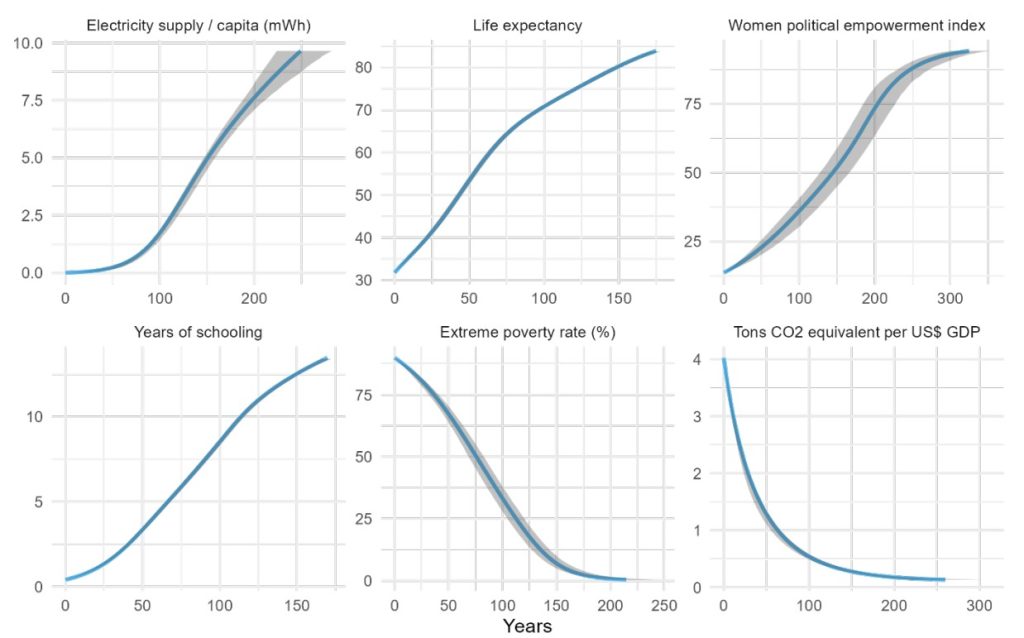
As shown in Figure 1, development does not follow a straight line. Progress is typically faster at some stages and slower at others, meaning traditional linear comparisons can be misleading.
The global slowdown
The main finding is clear:
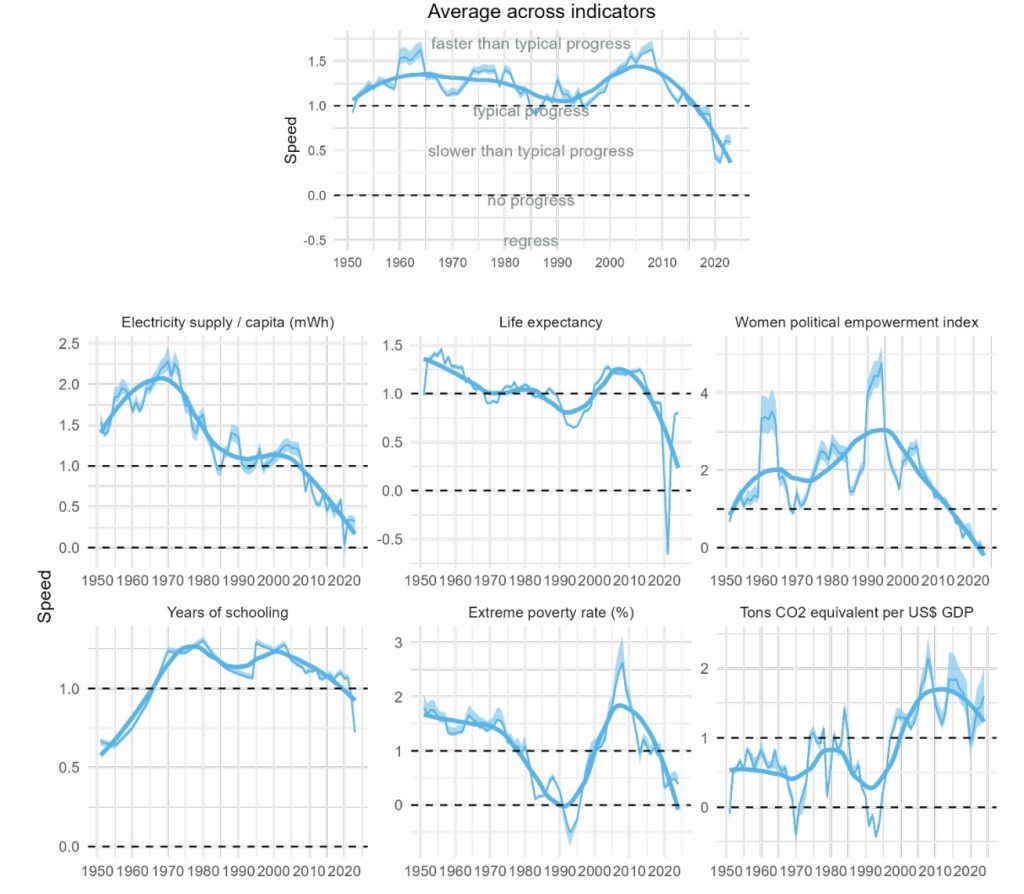
- Global development speed is now at its lowest level in 75 years
According to Figure 2:
- Life expectancy and electricity access show their slowest progress since 1950
- Education is at its slowest pace since the 1960s
- Poverty reduction has slowed to levels not seen since the 1990s
- Gender equality is reversing for the first time
This slowdown began around 2010 and was worsened—but not caused solely—by COVID-19.
Consequences
The impact is already significant. Compared to a scenario without slowdown:
- There would be 150 million fewer people in extreme poverty
- Life expectancy would be higher
- Gender equality would have improved more
If current trends continue, global poverty could stop declining and even increase.
Long-term outlook
The paper highlights a structural problem: development is extremely slow.
Reaching high-income standards can take 150–300 years depending on the indicator.
More concerning:
- 54 countries are over 100 years away from reaching developed-country benchmarks at current speeds
These countries either:
- Have very low development levels, or
- Are experiencing stagnation or regression
Implications
The findings challenge how progress is evaluated:
- Global targets like the SDGs may be unrealistic if they ignore non-linear development
- Countries require context-specific goals, not uniform benchmarks
- Slower progress suggests structural issues: climate change, debt, conflict, and institutional decline
Conclusion
The paper’s message is direct:
Development is still happening, but far too slowly—and in some cases, it is reversing.
Without a significant acceleration, global inequality and poverty gaps will persist for generations.
Reference
Mahler, D. G., Serajuddin, U., Wadhwa, D., & Yonzan, N. (2026). The world is developing at its slowest pace in 75 years. World Bank. https://hdl.handle.net/10986/44655