
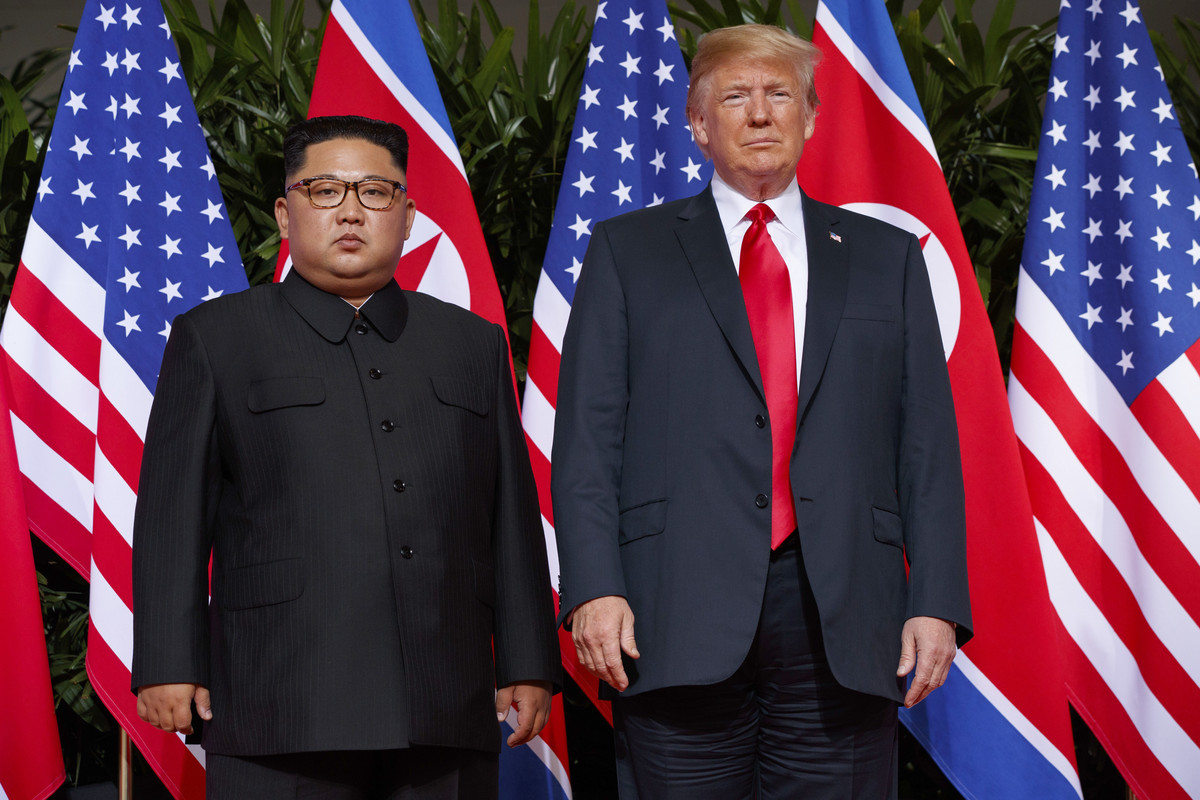
United States President Donald Trump intends to pivot his administration’s foreign policy focus toward North Korea’s nuclear weapon program. Following a recent framework agreement aimed at ending the war with Iran. During a G7 summit dinner in Evian-les-Bains, France, Trump communicated to South Korean President Lee Jae Myung that the time had come to actively address the North Korean dilemma. In response, President Lee urged a strategic reassessment. Emphasizing that long-standing international sanctions have become structurally ineffective. Lee specifically highlighted Pyongyang’s deepening military cooperation with Moscow. Noting that even minimal material or technological assistance from Russia significantly bolsters North Korea’s strategic positioning.
This shifting Western focus coincides with a period of intense diplomatic outreach by North Korean leader Kim Jong Un to solidify his traditional alliances. Beyond dispatching troops and ammunition to support Russia’s war effort in Ukraine. Kim recently hosted Chinese President Xi Jinping in Pyongyang. This high-profile meeting followed consecutive bilateral summits held by Xi in Beijing with both Trump and Russian President Vladimir Putin. Crucially, official readouts from the Sino-North Korean summit completely omitted any mention of denuclearization. A development geopolitical experts interpret as a tacit acceptance of North Korea’s nuclear status by Beijing.
Pyongyang has consistently maintained that its status as a nuclear power is irreversible since the collapse of the 2019 Hanoi summit. Which faltered over the reciprocal scope of sanctions relief and weapons dismantling. Rather than rolling back operations, Kim has actively expanded weapons development. In addition, recently revealing a new production facility for nuclear bomb fuel. While Trump met with Kim three times during his first term and recently reiterated an open invitation for a dialogue. His diplomatic overtures have remained unanswered. Furthermore, Trump has fundamentally departed from decades of established American foreign policy orthodoxy. By publicly characterizing North Korea as a functioning nuclear power, hinting at a more pragmatic, containment-based approach rather than pursuing absolute denuclearization.
In conclusion, the prospective shift in Washington’s strategy reflects a growing acknowledgment of changing geopolitical realities in East Asia. Where traditional isolation tactics have failed to halt Pyongyang’s nuclear ambitions. As North Korea successfully integrates itself into a broader security axis with Russia and China. The United States is being forced to transition away from obsolete sanctions frameworks. Ultimately, any new American policy will likely have to navigate an altered landscape. Where North Korea’s nuclear capabilities are treated as an established reality rather than a negotiable point of leverage.
Reference
Jazeera, A. (2026, June 19). Trump hints at new approach to North Korea’s nuclear programme. Al Jazeera. https://www.aljazeera.com/news/2026/6/19/trump-hints-at-new-approach-to-north-koreas-nuclear-programme