
The Trump administration is rapidly integrating artificial intelligence across the federal government, pushing agencies to adopt AI at scale and with minimal bureaucratic friction. A directive from the White House Office of Management and Budget in April urged agencies to deploy “innovative American AI”. Action that triggered a sharp increase in AI use across policing, immigration, health care, defense, and scientific research. Federal disclosures show nearly 3,000 active AI use cases projected by the end of 2025. Many of these adoptions are labeled “high impact,” meaning they directly influence decisions affecting people’s rights or safety.
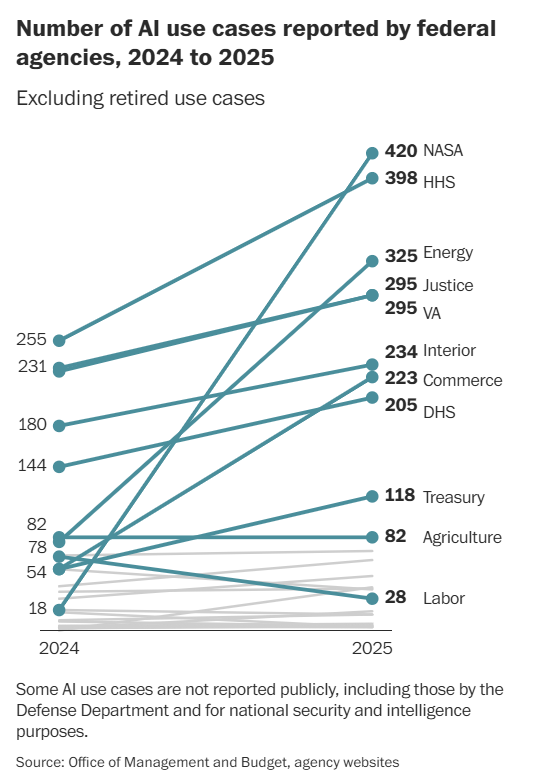
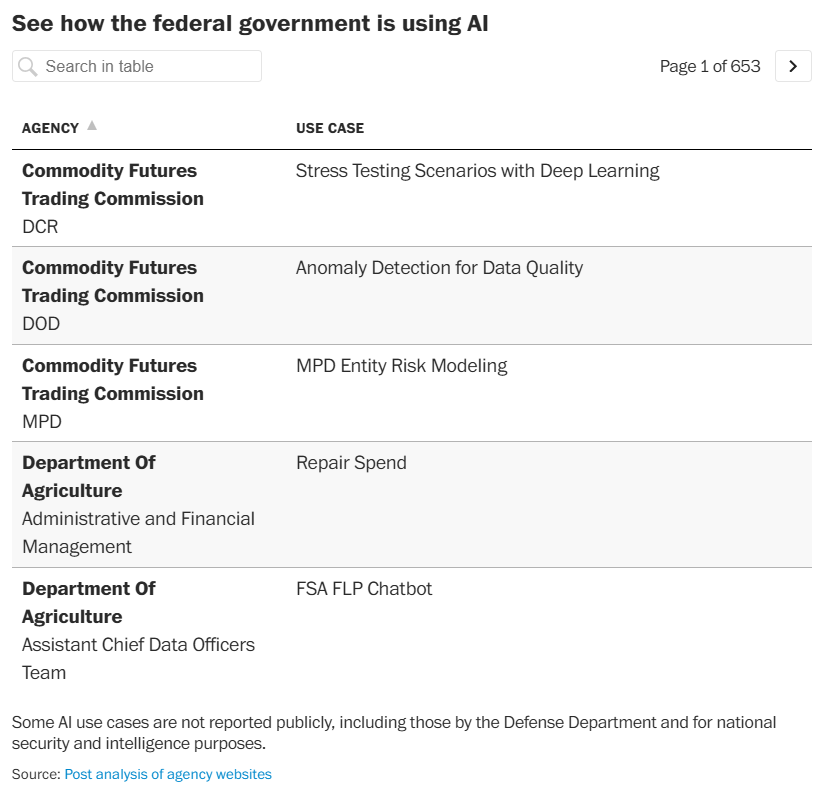
The White House frames this expansion as a necessary step to modernize government and improve efficiency. However, the disclosures offer little insight into how effective or accurate these tools are in practice. Experts warn that the administration’s emphasis on speed risks sidelining safeguards, oversight, and risk management, particularly as AI systems are increasingly used in sensitive contexts.
Turbocharged law enforcement
Law enforcement and immigration agencies account for a significant share of new AI deployments. The Department of Homeland Security has expanded facial recognition systems and adopted tools to identify individuals for deportation. ICE now uses mobile facial scanning in the field and a generative AI system from Palantir to extract addresses from handwritten records, supporting enforcement operations. While agencies insist AI does not serve as the sole basis for enforcement actions, civil liberties advocates raise concerns about opacity, errors, and the limited detail provided in public disclosures.
The Justice Department and FBI have also adopted AI tools to sift through images, text, and tips to generate investigative leads. Analysts note that vague descriptions of these systems make it difficult to assess their accuracy, bias, or potential consequences for those affected.
A Veterans Affairs boom
The Department of Veterans Affairs leads the government in high-impact AI use, reporting 174 tools aimed at improving health care delivery and benefits administration. Projects include systems to assess suicide risk, assist with surgery preparation, analyze wounds, and help veterans navigate benefit claims. The VA emphasizes that AI serves only as a support tool and that human staff retain decision-making authority. Yet, veterans’ groups stress the need for careful oversight to prevent errors in decisions with lasting consequences for veterans and their families.
Chatbots
AI adoption also extends to routine government operations. Agencies now operate at least 180 chatbots to assist employees with administrative tasks, internal rules, writing regulations, and contract decisions. Since staff is widespread, they describe AI as a force multiplier that allows smaller teams to complete work previously handled by much larger staff. Statement that is reinforcing the administration’s argument that AI can offset workforce reductions.
National security
Although the Pentagon is exempt from public AI disclosures, internal memos and procurement requests reveal an aggressive push to deploy advanced AI systems. Defense officials have been instructed to prioritize speed and flexibility over caution, treating AI risk decisions with wartime urgency. The Pentagon is actively seeking “agentic” AI systems capable of complex decision-making for special operations. This while attempting to limit risks in lethal contexts by restricting real-time learning during combat scenarios.
Science and reserach
Federal scientists are applying AI to a wide range of research and monitoring tasks, from tracking whale populations and invasive species to analyzing satellite imagery for agriculture and public health risks. Agencies such as NOAA and the National Archives are using AI to process datasets and improve public access to information, including newly digitized historical records. These projects highlight AI’s potential to accelerate research and discovery, even as questions remain about transparency and long-term governance.
Reference
Duncan, I., Merrill, J., Schaul, K., & Dou, E. (2026, February 9). Trump set off a surge of AI in the federal government. See what happened. The Washington Post. https://www.washingtonpost.com/technology/2026/02/09/trump-administration-ai-push/