
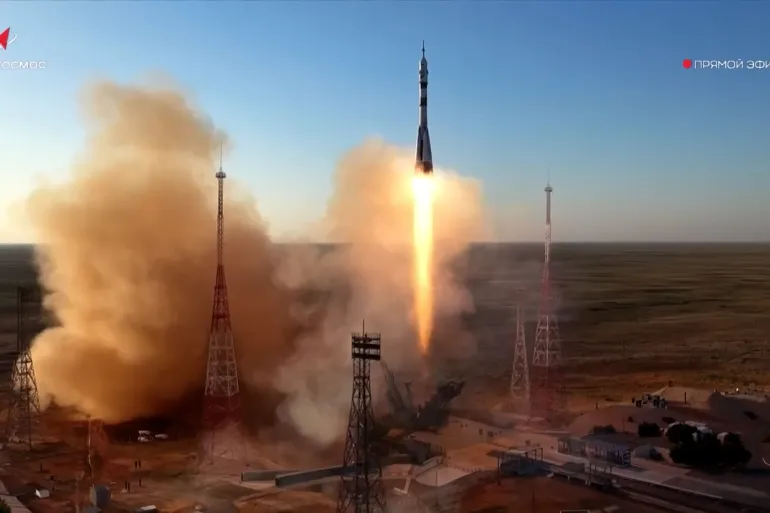
A joint United States and Russian space mission has successfully launched from the Baikonur Cosmodrome in Kazakhstan. Marking a rare and persistent area of cooperation between the two nations despite deep geopolitical tensions. The Soyuz MS-29 spacecraft carried NASA astronaut Anil Menon on his first space flight. Alongside veteran Roscosmos cosmonauts Pyotr Dubrov and Anna Kikina who are embarking on their second. The crew successfully entered orbit and is scheduled to dock at the International Space Station. Where they will reside and conduct research for an eight-month mission alongside an international cohort of American, Russian, and European astronauts.
The launch was notable for a rare high-level diplomatic visit, as NASA Administrator Jared Isaacman traveled to the Russian-operated spaceport for the first time a NASA chief. Has visited Baikonur in eight years. During his visit, Isaacman met with Dmitry Bakanov. The head of Russia’s state space corporation Roscosmos and expressed his gratitude to the Russian team. He praised the integrated preparation over the preceding months. Highlighting the professionalism and dedication of everyone involved in ensuring the mission’s success. This high-level interaction underscores how both agencies continue to prioritize operational safety and scientific continuity above terrestrial political disputes.
While cooperation on the space station remains intact, the broader landscape of joint space exploration has dramatically shifted. The geopolitical fallout from the war in Ukraine has effectively dissolved plans for wider collaboration. Such as Russian participation in NASA’s Artemis lunar research program. Faced with sweeping Western economic sanctions, Russia has pivoted its strategic and technological alliances eastward. Roscosmos has increasingly aligned itself with China. Initiating joint efforts on a prospective lunar mission as part of Russia’s broader economic and technological reliance on Beijing.
In conclusion, the successful launch of the Soyuz MS-29 serves as a powerful reminder of the enduring, pragmatic partnership between the United States and Russia in low-Earth orbit. Even as broader diplomatic ties fracture and separate, competing coalitions form for future lunar exploration. The International Space Station continues to function as a unique sanctuary of international scientific collaboration. Ultimately, the survival of this joint mission demonstrates that the shared operational necessity of space exploration can still transcend deep geopolitical divisions on Earth.
Reference
Jazeera, A. (2026, July 14). US, Russian astronauts launch into orbit for joint space mission. Al Jazeera. https://www.aljazeera.com/news/2026/7/14/us-russian-astronauts-launch-into-orbit-for-joint-space-mission