
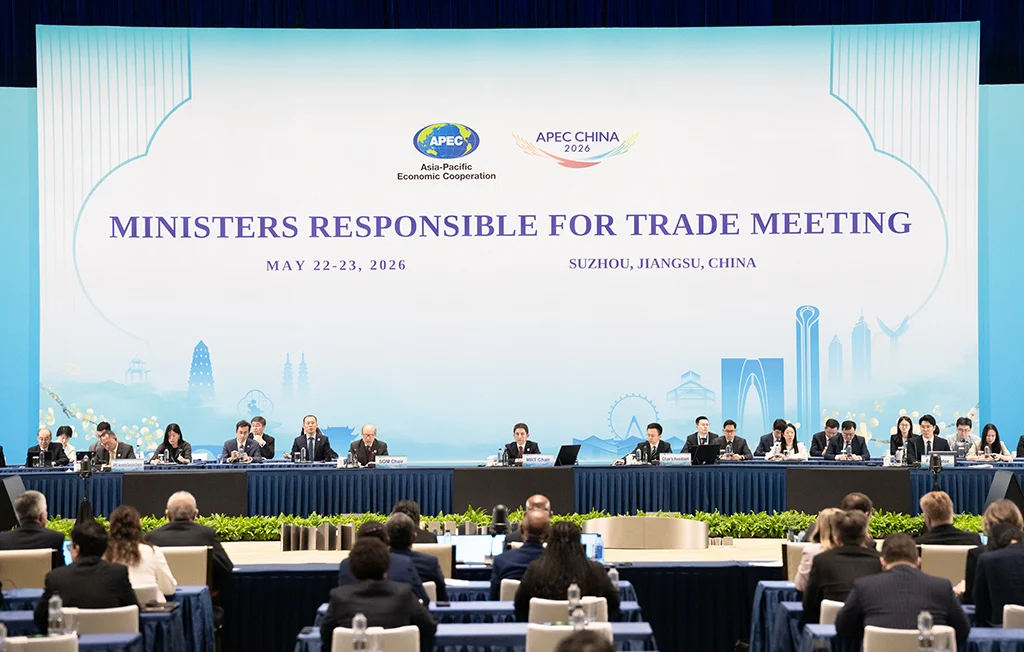
APEC trade ministers reaffirmed their commitment to open and rules-based trade during a period marked by economic uncertainty, geopolitical tensions, and rising protectionist pressures. The cooperation was framed as necessary to strengthen supply chains and preserve stability and growth across the Asia-Pacific. At the same time, the statement acknowledged that growing disruptions continue to challenge international trade systems and test multilateral coordination.
Support for the multilateral trading system remained central. Many ministers emphasized the importance of a predictable and transparent framework, with strong backing for the World Trade Organization (WTO). A reform of the institution appeared especially urgent, given concerns about stalled negotiations and weakened dispute-settlement mechanisms. Although consensus around free trade remained visible, the need for reform suggested recognition that existing institutions struggle to respond effectively to current global conditions.
Regional economic integration was presented as a key objective. Economies expressed support for advancing the long-term vision of a Free Trade Area of the Asia-Pacific. Greater connectivity, lower trade barriers, and closer economic cooperation were also described as tools to improve resilience. However, the statement also reflected awareness that benefits from integration are unevenly distributed and require stronger coordination to avoid widening inequalities between economies.
On the other hand, the digital trade received considerable attention. Ministers supported efforts to improve digital infrastructure, encourage paperless trade systems, and strengthen interoperability between customs procedures. Artificial intelligence and emerging technologies were recognized as increasingly important for economic competitiveness. Yet these developments raised concerns about unequal access, regulatory gaps, and differences in technological readiness among economies, especially between highly developed and developing members.
Supply chain resilience emerged as another major priority. Recent disruptions linked to geopolitical conflicts, inflation and economic instability reinforced the need for stronger coordination. Ministers said that it is extremely important to maintain the flow of goods and services while reducing vulnerabilities. Business representatives also warned that additional trade restrictions could increase uncertainty, weaken investment confidence, and affect jobs and living standards across the region.
Sustainable and inclusive growth remained closely tied to APEC’s broader agenda. Trade was not presented only as an economic objective, but also as a mechanism to improve living conditions and expand opportunities. The meeting emphasized innovation, competitiveness, and fairer participation in economic gains. Still, the repeated focus on inclusion suggested ongoing concerns about whether economic growth alone can address persistent disparities between sectors, workers and economies.
The meeting concluded with a renewed call for cooperation despite political and economic tensions. Ministers stressed dialogue and collective action as necessary responses to instability. While broad commitments signaled shared priorities, the statement also reflected the challenge of transforming diplomatic consensus into concrete action within an increasingly fragmented global economy.
Reference: Asia-Pacific Economic Cooperation (APEC). (2026, May 23). 2026 APEC Ministers Responsible for Trade Joint Statement (Suzhou Statement). https://www.apec.org/meeting-papers/sectoral-ministerial-meetings/trade/2026-apec-ministers-responsible-for-trade-joint-statement