
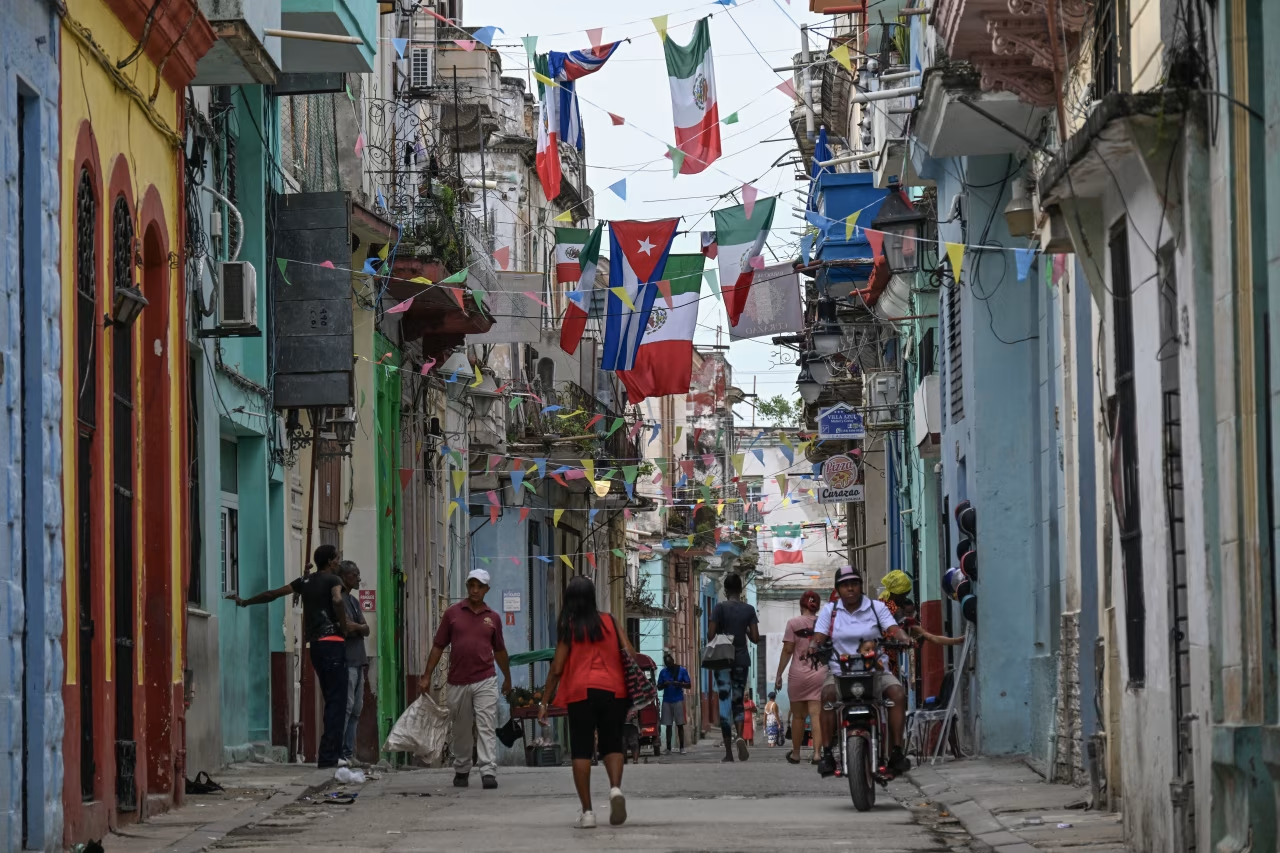
Cuba’s current crisis has revived long-standing expectations that the communist regime may finally be approaching its end. Yet the situation is more complex than many observers assume. The government faces severe economic deterioration, shrinking external support, and growing social pressures. However, its survival over several decades suggests that political endurance cannot be measured solely through economic performance. The regime has repeatedly demonstrated an ability to adapt to changing circumstances while preserving its core structures of power.
Unlike other communist governments that collapsed after the Cold War, Cuba developed a distinct survival strategy. Rather than embracing large-scale market reforms or pursuing complete isolation, authorities combined strict political control with carefully managed economic openings. Foreign investment was permitted in selected sectors, but always under conditions that protected state authority. Small private businesses were occasionally tolerated during economic emergencies, only to face renewed restrictions once conditions stabilized. This approach allowed the government to generate revenue while limiting challenges to its political dominance.
Another important source of resilience emerged from the Cuban diaspora. Large numbers of Cubans left the island, often in opposition to the government, yet many continued supporting relatives through remittances. These financial transfers became a crucial economic lifeline. In a striking contradiction, individuals who strongly opposed the regime frequently contributed to an economic system that depended on foreign currency flowing into the country. The arrangement helped reduce social pressures while providing the state with resources it could not easily obtain elsewhere.
The government also benefited from exporting labor. Cuban doctors, military personnel, and security workers participated in international missions whose payments were largely directed to the state. These programs generated valuable revenue while reinforcing the government’s ability to navigate periods of economic hardship. Although living standards remained low, such mechanisms contributed to the regime’s long-term durability.
Today, many of those support structures are weakening. Venezuelan assistance, once a critical pillar of the Cuban economy, has declined significantly. Tourism has deteriorated, foreign investment has retreated, and energy shortages have intensified economic difficulties. Under these conditions, remittances remain one of the few substantial sources of external income. The country therefore faces mounting economic strain at a moment when alternative sources of support have become increasingly limited.
Despite these challenges, predicting an imminent collapse may underestimate both the regime’s determination and its institutional experience. Cuban authorities have spent decades adapting to sanctions, economic crises, and diplomatic pressure. The political leadership has also avoided some of the internal divisions that weakened governments elsewhere. As a result, economic hardship alone may not be sufficient to produce rapid political change.
At the same time, the possibility of regime collapse raises difficult questions. Political transformation is often discussed as a desirable outcome, yet the disappearance of existing institutions could create significant instability. Years of economic decline have weakened much of the state’s administrative capacity. Many highly educated Cubans have emigrated, reducing the pool of professionals available to support reconstruction. A sudden breakdown could therefore trigger large migration flows, governance challenges, and opportunities for criminal organizations to expand their influence.
The debate ultimately extends beyond whether Cuba’s political system can survive. It concerns how change might occur and what consequences could follow. Economic pressure may weaken an authoritarian government, but it does not automatically produce a stable or prosperous alternative. The central challenge lies not only in achieving political transformation, but in ensuring that any transition avoids deeper social disruption and creates conditions for long-term recovery.
Reference: Mead, W. R. (2026, June 5). The perils of a Cuban collapse. The Wall Street Journal. https://www.wsj.com/opinion/the-perils-of-a-cuban-collapse-aa45695f?st=2k9DRz