
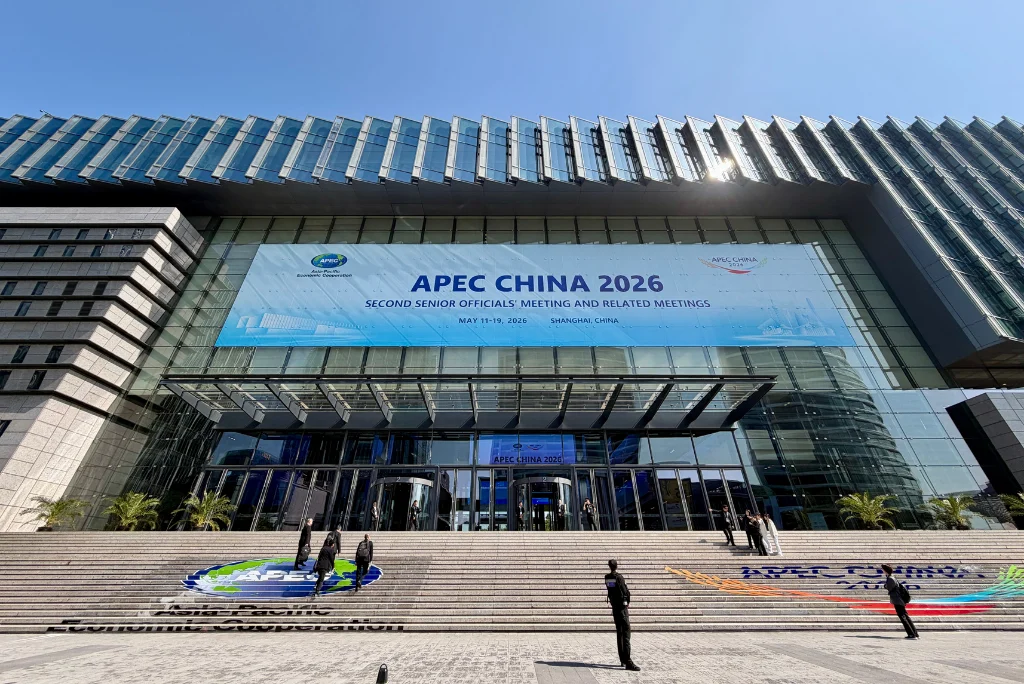
Growing trade uncertainty and shifting geopolitical conditions are placing new pressure on regional cooperation across the Asia-Pacific. In response, representatives from the 21 member economies of the Asia-Pacific Economic Cooperation (APEC) gathered in Shanghai for the Second Senior Officials’ Meeting (SOM2) and related discussions, held from 11 to 19 May. More than 40 meetings, workshops and dialogues focus on practical policy coordination in areas that increasingly shape economic resilience, including telecommunications, food safety, supply chains, trade facilitation and women’s economic participation.
Particular attention is given to how technological change is reshaping regional economies. Discussions on telecommunications and digital transformation emphasize artificial intelligence, digital trust and stronger technological resilience. The automotive sector also emerges as a priority, especially regarding electric, connected and autonomous vehicles, alongside concerns about workforce adaptation. These developments suggest a growing recognition that technological progress brings opportunities, but also uneven capacities among economies to benefit from digital transitions.
Food systems and logistics are treated as urgent regional concerns. Ongoing disruptions in shipping and supply chains have increased pressure to strengthen trade connectivity and port infrastructure. At the same time, food safety discussions highlight challenges linked to surveillance technologies, pesticide regulation and regulatory coordination. Cooperation appears necessary not only to improve efficiency, but also to reduce vulnerabilities that may disproportionately affect economies with weaker infrastructure or regulatory capacity.
Women’s economic empowerment also occupies an important place in the agenda. Policy dialogues focus on women’s leadership and participation in digital, care and green economies, reflecting wider concerns about unequal access to emerging opportunities. Yet these conversations also point to a broader challenge: economic growth alone does not guarantee inclusion if structural inequalities remain unresolved.
Rather than presenting cooperation as an abstract diplomatic goal, the meetings emphasize practical coordination in response to shared uncertainty. Regional stability is framed as increasingly dependent on collective action, especially at a moment when economic turbulence and geopolitical tensions continue to test existing forms of cooperation. The outcomes of these discussions are expected to shape later ministerial negotiations on trade and regional economic integration.
Reference: APEC. (2026, May 11). APEC strengthens regional cooperation in Shanghai amid growing trade uncertainty. https://www.apec.org/press/news-releases/2026/1105_som2