
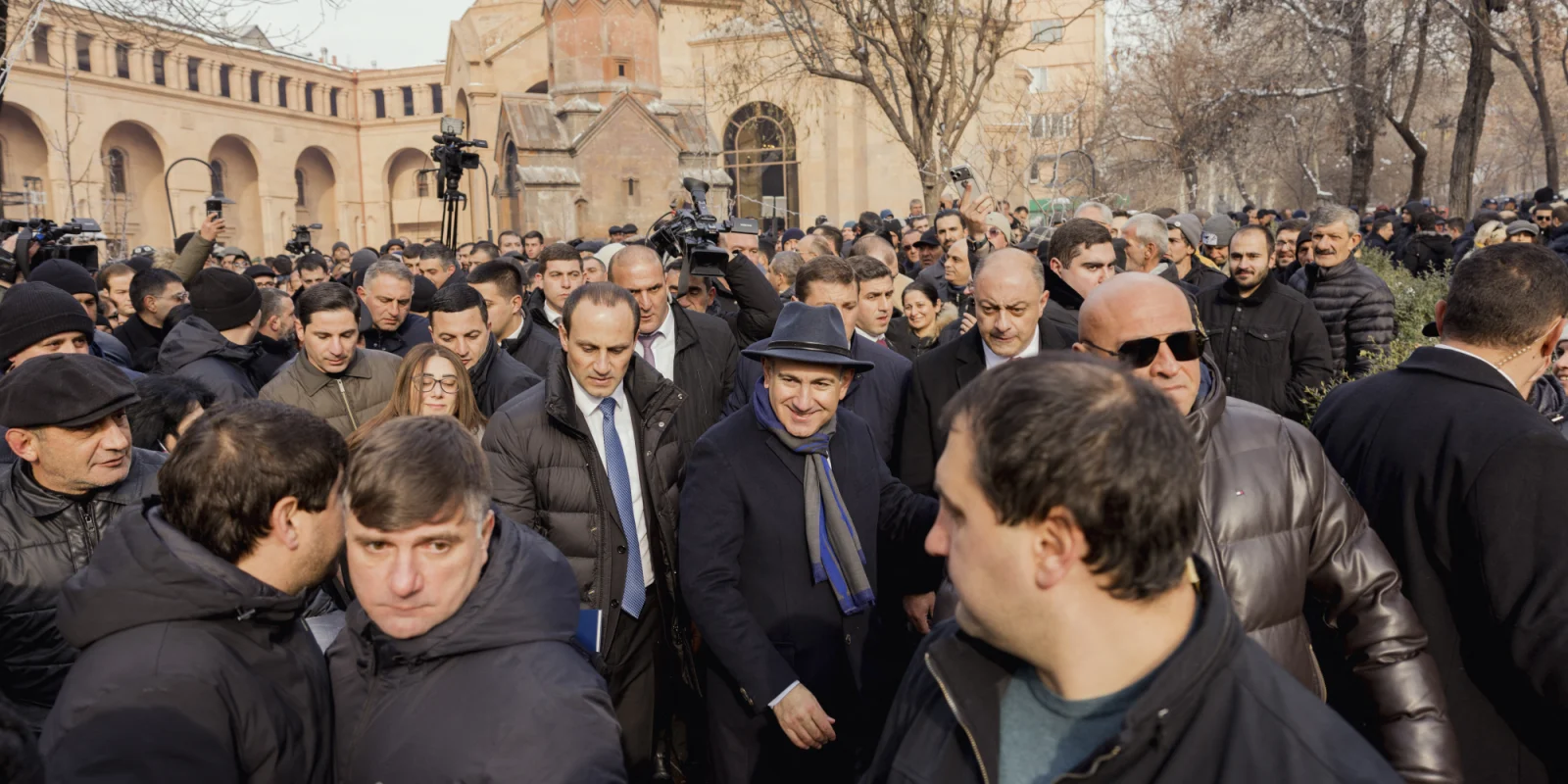
Armenia’s upcoming parliamentary election has become a decisive test for Prime Minister Nikol Pashinyan and the political direction he has pursued since the country’s military defeat in Nagorno-Karabakh. The vote is expected to revolve around a question that extends beyond party competition: whether Armenian society is willing to support a strategy centered on normalization and peace with neighboring Azerbaijan after years of conflict, loss, and political upheaval.
Pashinyan has argued that Armenia must adapt to a new regional reality. His government has promoted negotiations with Azerbaijan, sought to reduce dependence on historical nationalist narratives, and encouraged a foreign policy focused on stability and economic development. Supporters view this approach as a pragmatic response to changing geopolitical conditions. They argue that continued confrontation would place additional strain on a country facing security challenges, demographic pressures, and economic uncertainty.
Yet the peace agenda remains deeply controversial. Many Armenians associate recent diplomatic efforts with painful concessions following the loss of Nagorno-Karabakh and the displacement of its Armenian population. For critics, normalization risks legitimizing outcomes they consider unjust while offering limited guarantees for Armenia’s long-term security. These concerns have allowed opposition groups to frame the election as a judgment on national dignity, sovereignty, and the government’s handling of the conflict.
Public dissatisfaction has not translated into a unified opposition. Political rivals remain fragmented and often struggle to present a coherent alternative vision. While criticism of Pashinyan is widespread in some sectors, divisions among opposition forces have complicated efforts to transform frustration into an effective electoral challenge. This dynamic has helped the prime minister maintain political relevance despite repeated crises and declining public trust.
The election is also shaped by broader regional transformations. Russia’s influence in the South Caucasus has weakened considerably since the war in Ukraine, reducing its ability to act as Armenia’s primary security guarantor. At the same time, Armenia has sought closer engagement with Western partners while attempting to navigate a complex relationship with neighboring powers. These shifts have forced Armenian leaders to reconsider long-standing assumptions about security and foreign policy.
Underlying the debate is a difficult dilemma. Pursuing peace may offer opportunities for economic cooperation, regional connectivity, and greater stability. However, many citizens remain unconvinced that reconciliation can succeed without stronger safeguards and accountability for past conflicts. The challenge therefore extends beyond diplomacy itself. It involves rebuilding public confidence in a process that many perceive as unequal and politically sensitive.
Questions of identity also play a central role. The government’s efforts to redefine Armenia’s place in the region have sparked debate over how national history should be understood and how collective memory should influence future policy choices. For some voters, adapting to new realities is necessary for survival. For others, such adaptation risks abandoning principles that have long shaped Armenian political life.
The election ultimately represents more than a contest for political power. It reflects a broader struggle over how Armenia should respond to a transformed geopolitical environment and whether a society marked by conflict and displacement is prepared to embrace a different vision of security. The outcome will help determine not only the future of Pashinyan’s government but also the extent to which peace, rather than confrontation, can become the foundation of Armenia’s next political chapter.
Reference: Broers, L. (2026, May). Armenia’s election: Voters decide on Pashinyan’s peace agenda. Chatham House. https://www.chathamhouse.org/2026/05/armenias-election-voters-decide-pashinyans-peace-agenda