
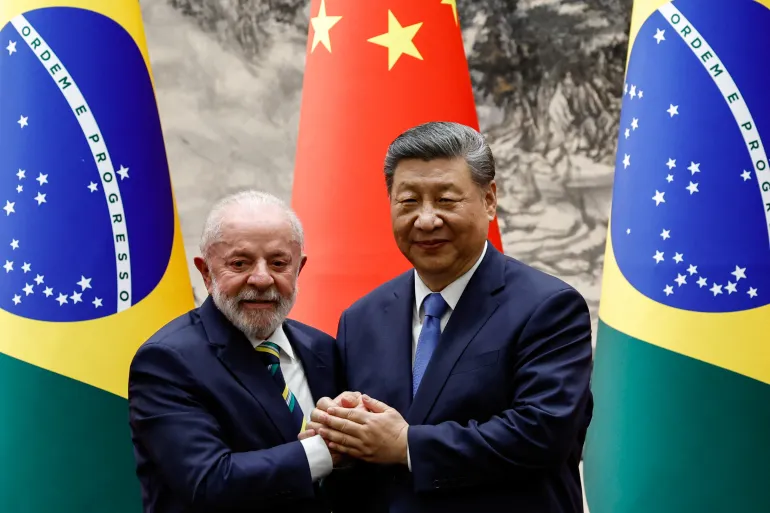
China and India are among the countries that have increased their imports on Brazilian crude oil after the disruptions of the Strait of Hormuz.
Because of the harder access to oil, especially the one of Russian supply that is constrained by sanctions, Asian buyers such as China and India are looking for suppliers who are more safer and reliable, such as Brazil.
Firstly, Brazil has not significantly increased its short-term production capacity (only rising from 3.77 million bpd in 2025 to ~4.11 million bpd in May 2026). Instead, its financial gains stem from redirecting its supply. State oil company Petrobras is diverting oil away from the U.S. (dropping to zero bpd) and toward Asian markets willing to pay a premium for secure logistics. China imports Brazilian crude nearly doubled—surging from ~704,000 bpd in 2025 to 1.316 million bpd between January and May 2026. The value of these first-quarter exports skyrocketed by 95% to $7.2 billion.
At the same time, India has more than doubled its imports from 100,000 bpd in 2025 to 238,000 bpd in early 2026, making Brazil India’s fourth-largest crude supplier. Consequently, with other Asian nations leading the way of expanding relations with Brazil. Obviously both diplomatic and economic, such as Japan and South Korea to guarantee energy security.
In addition, the redirection of oil is bolstering Brazil’s trade balance. The OECD reports that rising global crude prices are significantly supporting the country’s economy. Evidently, Brazil’s Ministry of Finance estimates that with Brent crude reaching $100 per barrel. Henceforth, the resulting revenue will generate a surplus equivalent to roughly 1% of the country’s GDP above initial 2026 budget projections.
Furthermore, Brazil’s premier export grades (Tupi and Buzios) are “medium-sweet” crudes with low sulfur levels. Making them highly efficient for refining into vital transport fuels like diesel and jet fuel. Evidently, giving Brazil a sharp advantage over other alternatives being promoted by the West. Such as Venezuelan crude, which is “heavy and sour” and cannot be processed by many Asian refineries.
Despite the benefits in the nation, the long-Term Structural Bottlenecks are present. Analysts warn that Brazil is a crucial marginal alternative during this supply crisis, but it cannot structurally replace Middle Eastern oil long-term due to several constraints. First, the distance and freight costs, where shipping oil from Brazil to China takes roughly 50 days, tying up tankers and increasing shipping costs. Also, as Arctic shipping routes seasonally reopen, Russia can ship oil to China in half the time of Brazil. Additionally, extended U.S. sanctions waivers on floating Russian crude make it a highly competitive alternative. Finally, Brazil lacks the short-term flexibility to rapidly ramp up raw extraction capacity to fully match global deficits.
Ultimately, while Brazil lacks the immediate infrastructure and capacity to structurally replace Middle Eastern oil long-term. The conflict in Iran has allowed it to leverage its highly efficient and vital lifeline for energy-starved Asian markets. Consequently, by redirecting its exports away from the United States to fulfill soaring demands in China and India, Brazil has captured an immense economic windfall solidifying its role as a geopolitically secure alternative in a destabilized global energy landscape.
Reference
Magee, C. (2026, May 25). Could Brazilian oil emerge as one of the big winners of the Iran war? Al Jazeera. https://www.aljazeera.com/news/2026/5/25/could-brazilian-oil-emerge-as-one-of-the-big-winners-of-the-iran-war