
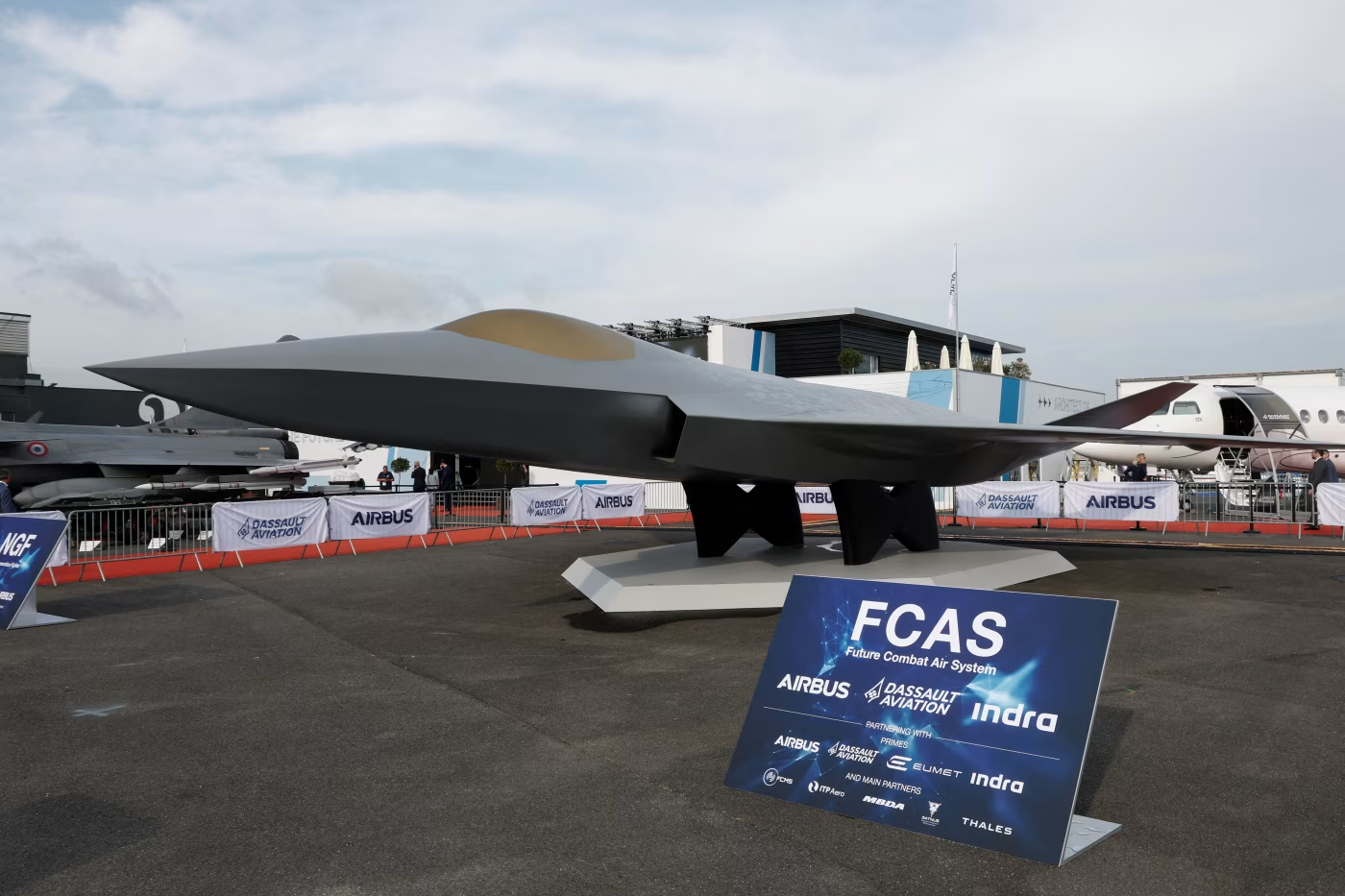
Europe’s ambition to build a truly independent defense industry has suffered a significant setback with the collapse of its most ambitious military aviation project. After years of negotiations, political declarations and technical planning, Germany decided to withdraw from the fighter jet component of the Future Combat Air System (FCAS), a joint initiative launched with France and later joined by Spain. The decision marks the end of a project that was once presented as a symbol of Europe’s ability to reduce its dependence on foreign military technology and develop strategic autonomy at a time of mounting security challenges.
The breakdown was not caused by a lack of resources or political urgency. Rather, it reflected a problem that has repeatedly complicated European defense cooperation: competing national interests. At the center of the dispute stood two aerospace giants, Airbus and Dassault Aviation, which spent years disagreeing over leadership and responsibility, as well as intellectual property rights. What began as a technical disagreement gradually evolved into a deadlock that neither governments nor mediators could resolve.
The collapse is particularly striking because it comes at a moment when European governments are under growing pressure to strengthen their military capabilities. Russia’s continued aggression in Eastern Europe and uncertainty about the future role of the United States in European security have intensified calls for greater defense self-reliance. FCAS was designed to answer that challenge through a sixth-generation combat aircraft supported by drones and artificial intelligence. Instead, the project became a reminder of how difficult it remains for European states to transform political aspirations into joint military capabilities.
Beneath the industrial dispute lay deeper strategic differences. France envisioned an aircraft capable of supporting its nuclear deterrent and operating from aircraft carriers. Germany, whose military priorities differ significantly, questioned whether those requirements matched its own long-term defense needs. As the gap widened, disagreements over technology increasingly reflected contrasting visions of national security.
The outcome highlights a recurring tension within European integration. While governments often emphasize unity in response to external threats, cooperation becomes more complicated when issues of industrial leadership, technological control, and national interests enter the equation. Defense projects require not only shared objectives but also agreement over who leads, who benefits, and whose strategic priorities take precedence. FCAS struggled on all three fronts.
Not all elements of the initiative will disappear. Germany, France and Spain are expected to continue collaborating on certain technologies, including the so-called “combat cloud,” a digital network designed to connect aircraft, drones, satellites and military systems in real time. Yet preserving these components does little to conceal the symbolic significance of losing the centerpiece of the program: the aircraft itself.
The failure of FCAS raises broader questions about Europe’s defense future. Calls for strategic sovereignty have become more and more common, but sovereignty depends on the ability of governments and industries to cooperate on projects that are expensive, technologically complex and politically sensitive. The collapse of Europe’s flagship fighter jet program suggests that achieving that goal may prove far more difficult than many leaders anticipated. At a time when external threats are encouraging closer coordination, internal divisions continue to reveal the limits of European defense integration.
Reference: Benoit, B. & MacDonald, A. (2026, June 8). Germany drops jet project with France in setback for European defense sovereignty. The Wall Street Journal. https://www.wsj.com/world/europe/germany-drops-jet-project-with-france-in-setback-for-european-defense-sovereignty-3f7a8b27