
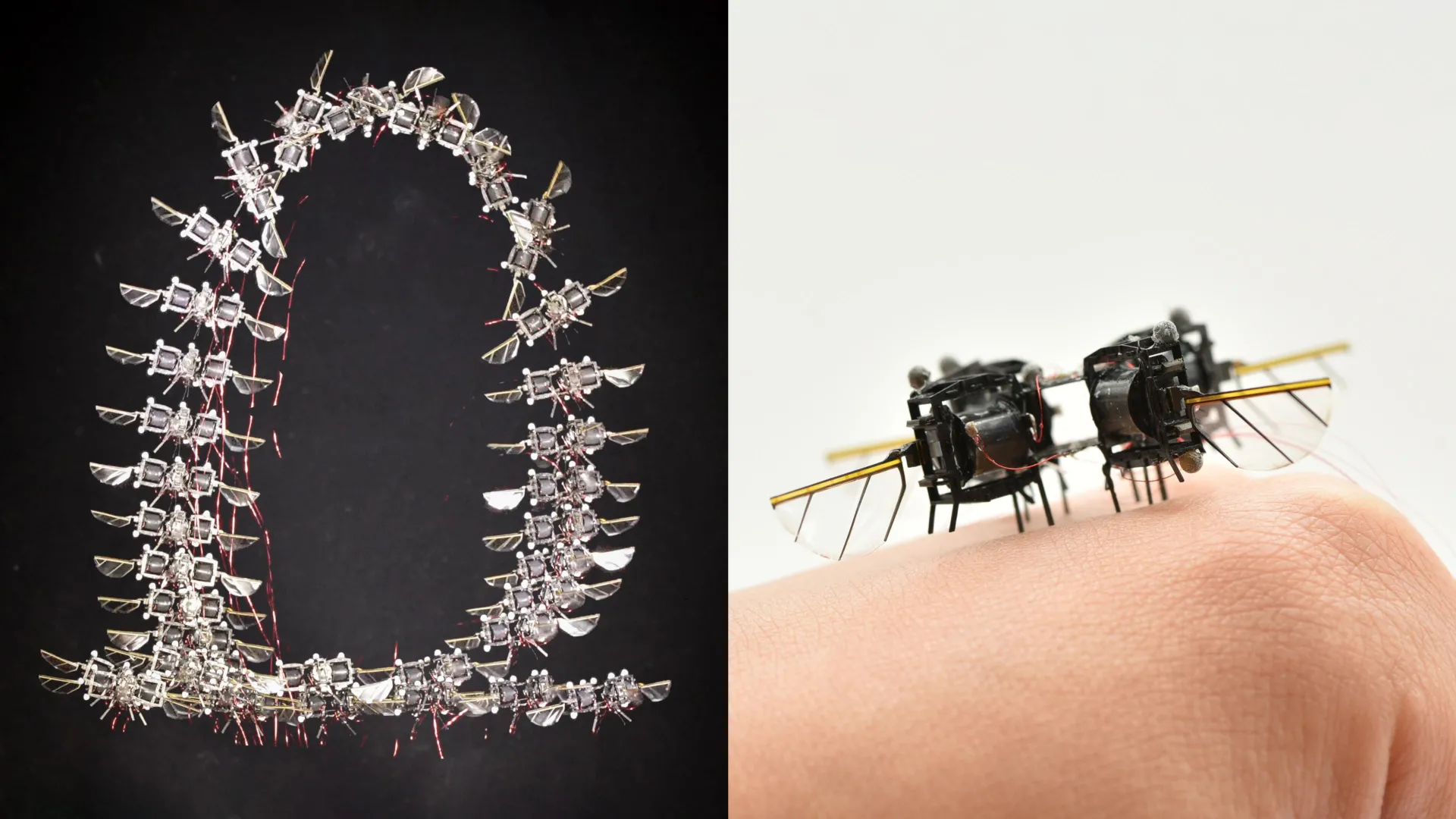
The article describes a new artificial intelligence-based control system developed by researchers at the Massachusetts Institute of Technology (MIT) that significantly improves the speed and agility of an insect-scale flying robot. The tiny robot is approximately the size of a microcassette and weighs less than a paperclip. By combining advanced robotics with artificial intelligence, the researchers were able to increase its speed by about 447 percent and its acceleration by 255 percent compared with previous results. The robot can also perform complex aerial movements, including ten consecutive somersaults in only 11 seconds.
The main challenge was developing a controller capable of managing the robot’s complicated flight dynamics in real time. Because the robot is extremely small and lightweight, its movements are highly sensitive to disturbances and small errors. To address this problem, the researchers created a two-stage control system. The first stage uses a model-predictive controller that calculates the best sequence of movements while considering the robot’s physical limitations. This system can plan difficult maneuvers such as sharp turns, flips, and rapid changes in body position.
The second stage uses deep learning and imitation learning. The researchers first used the more computationally demanding controller to generate expert flight behaviors and then trained an artificial intelligence model to reproduce those behaviors more efficiently. This allowed the robot to make decisions quickly enough for real-time flight. During experiments, the AI-controlled robot successfully performed repeated flips while staying within approximately four or five centimeters of its planned trajectory. The system also demonstrated a rapid movement called a “saccade,” which is inspired by the way insects quickly change their body position.
The researchers believe that this technology could eventually allow miniature flying robots to operate in environments where conventional drones have difficulty navigating. Because of their extremely small size, these robots could potentially move through narrow spaces, such as areas filled with debris after an earthquake. Future research will focus on adding onboard cameras and sensors so the robots can operate without external motion-capture systems. The team also plans to investigate how multiple robots could coordinate their movements and avoid collisions. Overall, the research demonstrates how artificial intelligence and bio-inspired robotics can be combined to create small machines capable of highly agile and autonomous movement.
Link to the article: DOWNLOAD
Reference
- Massachusetts Institute of Technology. (2026, September 22). MIT’s tiny flying robot gets 450% faster with AI. ScienceDaily. ScienceDaily