
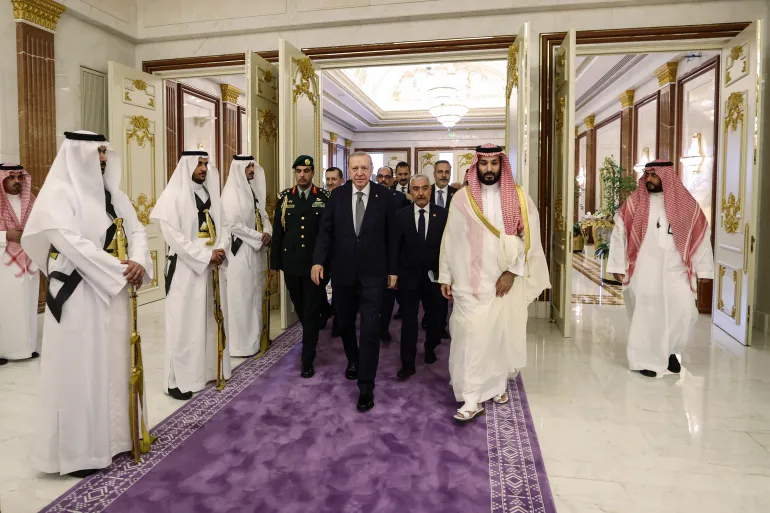
Saudi Arabia, Pakistan, and Turkiye have finalized details of a historic tri-lateral mutual defense pact. In this case establishing that an armed attack on any member state will be considered an attack against all three. Signed amid heightened regional tensions and conflict across the Middle East, the agreement creates a structured framework for institutional cooperation. Which includes joint military exercises, defense industry integration, and high-level coordination between defense ministers, foreign ministers, and military chiefs. Featuring the combined capabilities of a major economic leader, NATO’s second-largest military, and a nuclear-armed state, the alliance is open to expansion to other regional partners such as Egypt.
The core mechanisms of this new pact directly mirror historic and contemporary collective defense models established globally over the past century. Standard examples include NATO’s Article 5 provision, the 1950 Arab League Joint Defence Treaty, the 1947 Rio Treaty, and the 1951 ANZUS Treaty. Obviously, all of which established that an attack on one member state triggers a collective response.
Similarly, post-WWII bilateral agreements such as the US treaties with Japan and South Korea provided strategic nuclear umbrellas and allowed for permanent military deployments. More recent regional frameworks include the Gulf Cooperation Council’s Peninsula Shield Force, the European Union’s Article 42(7) mutual defense clause, and the Russia-led Collective Security Treaty Organisation (CSTO).
While collective security alliances historically serve as powerful deterrents against large-scale interstate warfare. In addition, defense analysts note that their practical effectiveness often declines during grey-zone conflicts, internal uprisings, or proxy warfare.
Consequently, such agreements frequently function as symbolic demonstrations of political solidarity rather than strictly operational defense triggers. Nevertheless, by formalizing strategic, military, and industrial integration among three prominent Muslim-majority powers. Ultimately, this deal creates a substantial new security axis designed to enhance long-term regional stability and deterrence.
Reference
Shamim, S. (2026, August 14). Mutual defence: The alliances that preceded Turkiye-Pakistan-Saudi pact. Al Jazeera. https://www.aljazeera.com/news/2026/8/14/mutual-defence-the-alliances-that-preceded-turkiye-pakistan-saudi-pact