
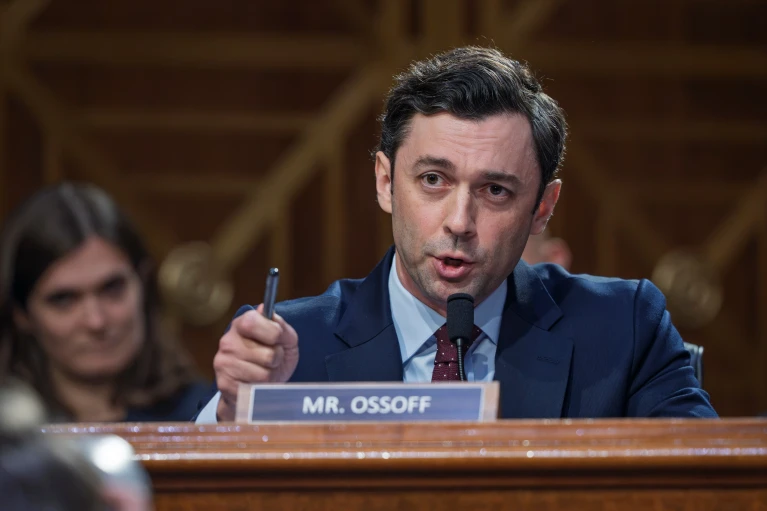
As the battle for control of Capitol Hill intensifies, the expanding Georgia Senate race reelection campaign reveals a dramatic shift in Democratic campaign strategy. Historically known for his disciplined, cautious, and policy-focused rhetoric, incumbent Senator Jon Ossoff has adopted a highly aggressive tone. Facing a tough challenge in a state recently won by the top of the Republican ticket, Ossoff is centering his entire messaging strategy on a direct assault against the White House.
From a Restrained Candidate to an Aggressive Critic
To understand the scale of this political shift, analysts must look back at the incumbent’s past campaign styles. During his high-profile 2020 run, Ossoff carefully avoided personal attacks against the president, focusing instead on structural policy debates.
According to campaign communications data, the second-term senator has discarded his cautious strategy, explicitly labeling the current presidential circle a “national disgrace.”
During a major campaign event in Savannah, Ossoff blasted what he described as an era of absolute federal disarray. He targeted the administration’s controversial tax adjustments, ongoing legal shields, and an untracked regional conflict. Consequently, the Georgia Senate race reelection campaign has transformed from a localized state race into a direct national referendum on executive power.
Trump Endorsement Sets the Republican Fault Line
This sharp increase in political tension follows a decisive Republican primary runoff. Second-term Congressman Mike Collins secured the GOP nomination to challenge Ossoff following a crucial, last-minute endorsement from the White House.
Collins has successfully unified the state’s conservative base by identifying himself as a dedicated warrior for the “Make America Great Again” movement. The businessman frequently criticizes Ossoff’s lack of private sector experience, arguing that Washington needs leaders who understand local payroll structures. As a result, the race presents voters with two entirely conflicting visions of governance and economic management.
The Massive Financial Scale of a Key Swing-State Battle
For national party strategists, this southern showdown represents the absolute highest-stakes defensive battle on the 2026 electoral map. Ossoff remains the sole Senate Democrat running for reelection in a state carried by the Republican presidential nominee two years ago.
Furthermore, historical data indicates that this matchup will trigger historic levels of outside campaign spending. Ossoff’s campaign apparatus reported raising over $60 million by early 2026, holding a massive $32 million cash-on-hand advantage. However, conservative political action committees are preparing a massive ad campaign to erase this structural advantage. Ultimately, this intense spending environment forces both operations to constantly optimize their messaging across digital media platforms.
A Crucial Fault Line for Congressional Control
Overcoming deep partisan divides in a closely split state will require an incredibly precise ground game from both parties. The traditional political playbooks that worked in previous cycles are being completely rewritten.
Moving forward, voters will be flooded with competing narratives regarding inflation, immigration enforcement, and judicial integrity. Success in this highly volatile environment requires maintaining immense energy across diverse regional voting blocs. Ultimately, the candidate who successfully shapes public perceptions of executive accountability will secure this vital seat and determine the balance of power in Washington.
Barrow, B. (2026, July 18). Sen. Ossoff fuels reelection campaign with attacks on Trump. Associated Press. https://apnews.com/article/jon-ossoff-donald-trump-mike-collins-b35cc90ec52f00194333aa47e093e8bd