
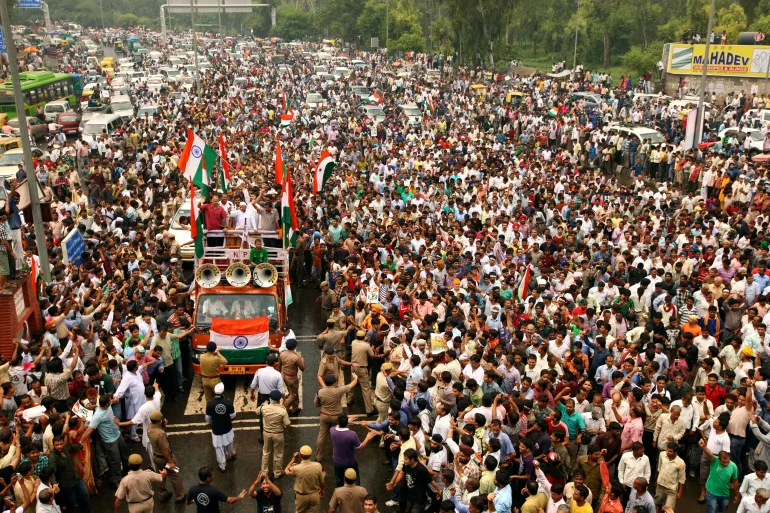
Thousands of demonstrators have recently flooded New Delhi to demand electoral reforms. Modern street protests in India draw from a deep historical legacy of mass resistance. In 1965, southern anti-Hindi agitations protected regional identities against federal language imposition. Consequently, English remained an official language.
In the mid-1970s, Jayaprakash Narayan led the “JP Movement” against government corruption. Furthermore, this broad coalition united opposition parties and defeated Prime Minister Indira Gandhi in 1977. Similarly, the 1990 Mandal Commission protests forced crucial affirmative action policies for disadvantaged castes. Meanwhile, economic liberalization in the 1990s triggered widespread labor strikes, though market reforms ultimately continued.
In recent decades, public agitations have repeatedly challenged ruling authorities. For instance, Anna Hazare’s 2011 anti-corruption movement sparked new political parties. Likewise, the 2012 “Nirbhaya” demonstrations forced strict amendments to sexual assault laws. Later, mass resistance against the Citizenship Amendment Act delayed key controversial policies. Most notably, historic farmer sit-ins forced Prime Minister Narendra Modi to repeal three major agricultural laws in 2021.
Today, youth activists of the “Cockroach Janta Party” continue this legacy of public dissent. After forcing out the education minister in July 2026, student groups are demanding the election chief’s resignation. Ultimately, active street protests in India demonstrate that public dissent remains a defining pillar of the nation’s democracy.
Reference: How protests have shaped India: From anti-Hindi agitation to farm laws | Protests News | Al Jazeera: https://www.aljazeera.com/news/2026/10/13/how-protests-have-shaped-india-from-anti-hindi-agitation-to-farm-laws