
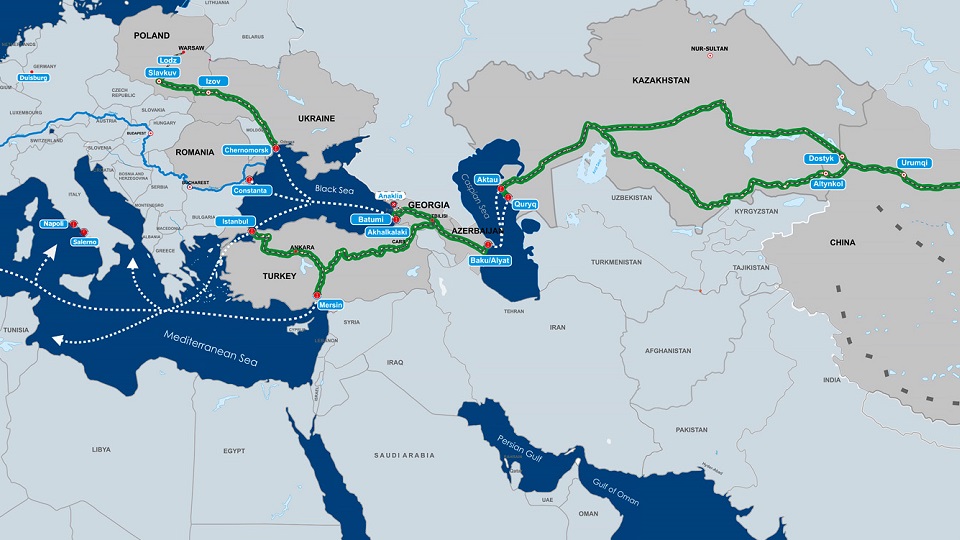
While the Middle Corridor was originally conceived and utilized primarily as a multi-modal transit route for moving dry goods and commercial cargo between Asia and Europe, it has entered a “new phase”, within Tukiye-Kazakhstan. Driven by recent high-level diplomatic meetings—including visits by Turkish Vice President Cevdet Yılmaz and President Recep Tayyip Erdoğan to Kazakhstan—the corridor’s focus is actively expanding into a major energy transport channel.
Two major global conflicts have fast-tracked the necessity of this energy corridor. First, the Russia-Ukraine War, where Western sanctions and geopolitical friction have made the traditional “Northern Corridor” (which goes through Russia) highly sensitive and politically unviable for Western buyers. On the other hand, the US-Israel-Iran Conflict, in which recent intense disruptions and naval blockades in the Strait of Hormuz have destabilized Middle Eastern energy shipments. This has forced European and global markets to desperately seek alternative, stable overland and Caspian supply routes that bypass both Russia and the Middle East.
For Kazakhstan, deepening energy ties with Türkiye via the Middle Corridor is a textbook exercise in “middle-power balancing” and niche diplomacy. It allows Kazakhstan to diversify its export pathways, drastically reducing its historical overdependence on Russian pipelines and it leverages Kazakhstan’s vast resource wealth (30 billion barrels of oil and 2.4 trillion cubic meters of gas) to gain geopolitical leverage and direct, unhindered access to European markets.
For Ankara, this integration cements Türkiye’s geographic destiny as the ultimate bridge between East and West. By ensuring that Kazakh oil and gas pass through its territory to reach Europe, Türkiye expands its regional influence, strengthens the institutional infrastructure of the Organization of Turkic States (OTS), and positions itself as a vital guarantor of European energy security.
The “energy dimension” isn’t just limited to crude oil and natural gas. The Middle Corridor is being mapped out to facilitate the future transit of clean energy, including green electricity and renewable hydrogen and critical minerals and rare earth elements (such as the massive, newly identified Zhana Kazakhstan site holding over 20 million metric tons of materials like neodymium and yttrium), which are vital for the West’s technology and green energy supply chains.
Despite the high strategic optimism, turning the Middle Corridor into a flawless energy highway faces steep, practical hurdles. First, the Infrastructure Capacity, with limited shipping and port facilities on the Caspian Sea (specifically at the Aktau and Kuryk ports). The Environmental Pressures which rapidly dropping water levels in the Caspian Sea threaten port accessibility. And the need for massive joint funding, tariff harmonization, and complex customs alignment across multiple transit nations (Kazakhstan, Azerbaijan, Georgia, and Türkiye).
In conclusion, while the Middle Corridor cannot fully replace older routes overnight, its value lies in strategic optionality. The energy dimension has effectively elevated the Türkiye-Kazakhstan relationship from a symbolic, culturally bound partnership into a hard economic and security alliance vital to the broader geo-economic architecture of Eurasia.
Reference
Burak Çalışkan. (2026, May 19). The Middle Corridor’s Energy Dimension: A New Phase in Turkiye-Kazakhstan Ties. Thediplomat.Com; The Diplomat. https://thediplomat.com/2026/05/the-middle-corridors-energy-dimension-a-new-phase-in-turkiye-kazakhstan-ties/