
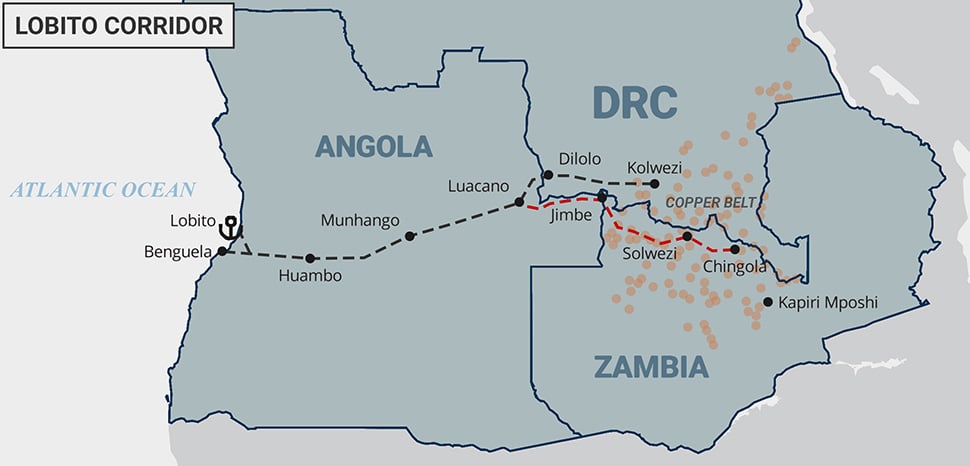
During his U.S. Senate confirmation hearing, the newly appointed Assistant Secretary of State for African Affairs, Frank Garcia, praised the Trump administration’s “America First”. This shift toward a trade-and-investment-focused policy in Africa. Garcia highlighted the Lobito Corridor as the prime model for this updated strategy. Emphasizing that U.S. engagement will prioritize job creation, economic integration, and commercial ties over traditional humanitarian assistance.
Firstly, the spanning 1,300 kilometers (810 miles), the Lobito Corridor is a vital rail and transport route. Linking the Atlantic port of Lobito in Angola to the mineral-rich regions of Zambia and the Democratic Republic of the Congo (DRC). Consequently, the underlying infrastructure rests on the historic Benguela Railway. Which was originally established during the colonial era in 1902 and later rehabilitated by China. While the initial diplomatic foundation for Western backing was laid under the Biden administration as a climate-transition project.
Subsequently the Trump administration aggressively re-mobilized funding to pivot the corridor into a geopolitical tool. Driven heavily by the International Development Finance Corporation (DFC). Which provided a massive $753 million financing package, the U.S. now frames the project as an essential asset to secure domestic supply chains. Therefore, critical minerals like copper, cobalt, lithium, and nickel, while actively countering China’s economic dominance on the continent.
Despite official enthusiasm, the project faces intense scrutiny from global development experts and human rights organizations. Critics argue that the corridor operates on a neocolonial framework that primarily benefits external Western strategic interests. Rather than bolstering intra-regional African trade. Obviously, serious concerns have been raised regarding local exploitation, as the railway snakes through volatile territories where mineral wealth has historically fueled conflict.
Furthermore, research by Global Witness indicates that up to 6,500 people in the DRC face potential displacement and property disputes due to the expansion. A United Nations policy document similarly warns of severe long-term risks. Including environmental degradation, land conflicts, and human rights abuses. Indicating that the multi-billion-dollar project remains a contentious litmus test for Western resource exploitation in Africa.
In short, the Lobito Corridor is a strategic win for the U.S. in securing critical minerals and countering China. Nevertheless, it faces heavy criticism for prioritizing foreign extraction over local populations. Ultimately, its success depends on whether it actually drives local development or simply repeats old patterns of resource exploitation.
Reference
Marsi, F. (2026, May 27). What is the Lobito Corridor, cited by US Africa envoy as model for ties? Al Jazeera. https://www.aljazeera.com/news/2026/5/27/what-is-the-lobito-corridor-cited-by-us-africa-envoy-as-model-for-ties