
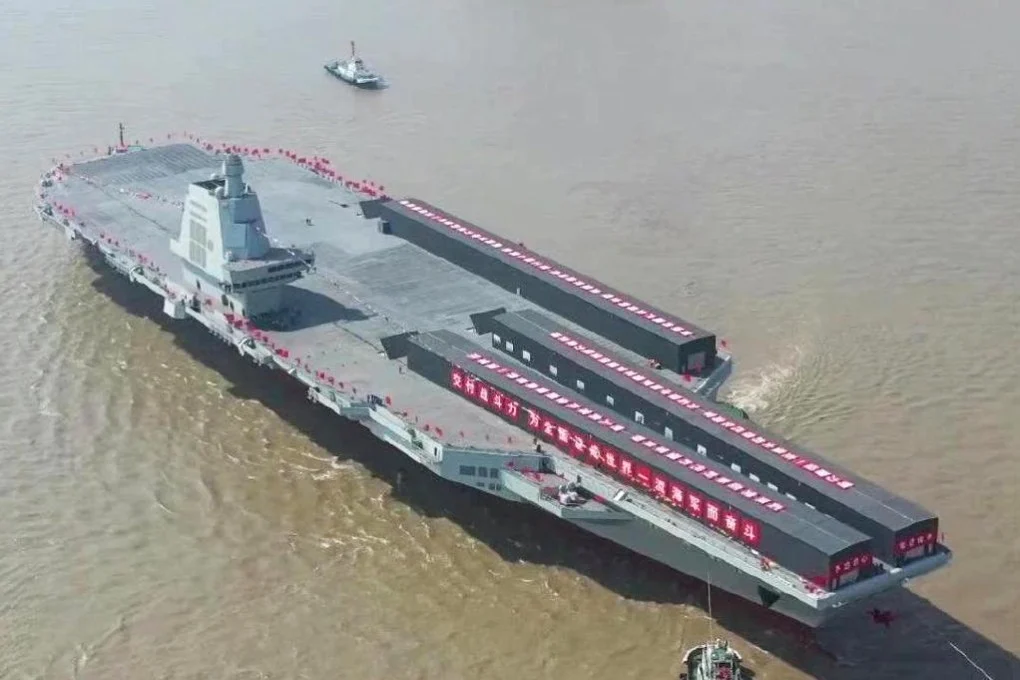
An assessment by the Center for Strategic and International Studies (CSIS) confirms with near certainty that China is currently constructing its fourth aircraft carrier. A vessel widely anticipated to be the Type 004 supercarrier. Analysts utilized satellite imagery from May 2026 to verify that the hull. Measuring approximately 286 meters in length and 46 meters in width, represents a massive surface combatant that far exceeds the size of any other class in the People’s Liberation Army Navy (PLAN). The unique hull configuration rules out any civilian commercial use. Moreover, mirrors the exact design patterns of China’s previous aircraft carriers at identical phases of assembly. Furthermore, the ship is being constructed in the precise graving dock previously utilized to refit the Liaoning and assemble the Shandong, firmly cementing its military identity.
The most groundbreaking revelation from the satellite data involves the carrier’s propulsion system. Which strongly indicates that the vessel will be nuclear-powered. Imagery captured on May 4, 2026, exposes two distinct 15-meter by 15-meter compartments within the hull. That feature the architectural hallmarks of shielded nuclear reactor containment structures designed to protect the crew from radiation. This feature was entirely absent on China’s conventionally powered third carrier, the Fujian, at a comparable stage of construction. In addition, while Chinese officials have acknowledged the existence of a fourth carrier program, they have steadfastly refused to comment on its propulsion. However, this imagery matches intelligence from late 2024. Which identified a land-based naval prototype reactor in Sichuan linked directly to the design institute responsible for China’s aircraft carriers.
Furthermore, transitioning to nuclear propulsion marks a monumental leap in power projection for the PLAN. Placing China into an elite naval tier alongside the United States and France. Nuclear reactors eliminate the constant logistical burden of refueling, allowing the carrier to operate for extended durations at higher speeds far from China’s shores. This system also generates the immense electrical power required to operate advanced onboard technology. Such as the electromagnetic catapults used to launch aircraft, while freeing up significant internal space for additional warplanes, fuel, and munitions. This aggressive expansion aligns with recent U.S. Department of Defense assessments. Indicating that China intends to field six additional aircraft carriers by 2035. Bringing its total projected fleet to nine as it seeks to match or exceed American naval capabilities.
In conclusion, the construction of China’s fourth aircraft carrier, with clear visual evidence of nuclear propulsion, marks a massive leap in the People’s Liberation Army Navy’s ability to project power globally. By shifting away from conventional power, China is removing its logistical refueling limits and freeing up internal space for more weaponry. Positioning itself alongside the world’s most elite blue-water navies. This technological milestone confirms Beijing’s aggressive push to build a multi-carrier fleet by 2035. In conclusion, significantly narrowing the naval capability gap with the United States and reshaping the strategic balance of power far beyond its coastal waters.
Reference
Funaiole, M. P. (2026, May 21). Tracking China’s Fourth Aircraft Carrier. Csis.Org. https://features.csis.org/hiddenreach/china-fourth-carrier/