
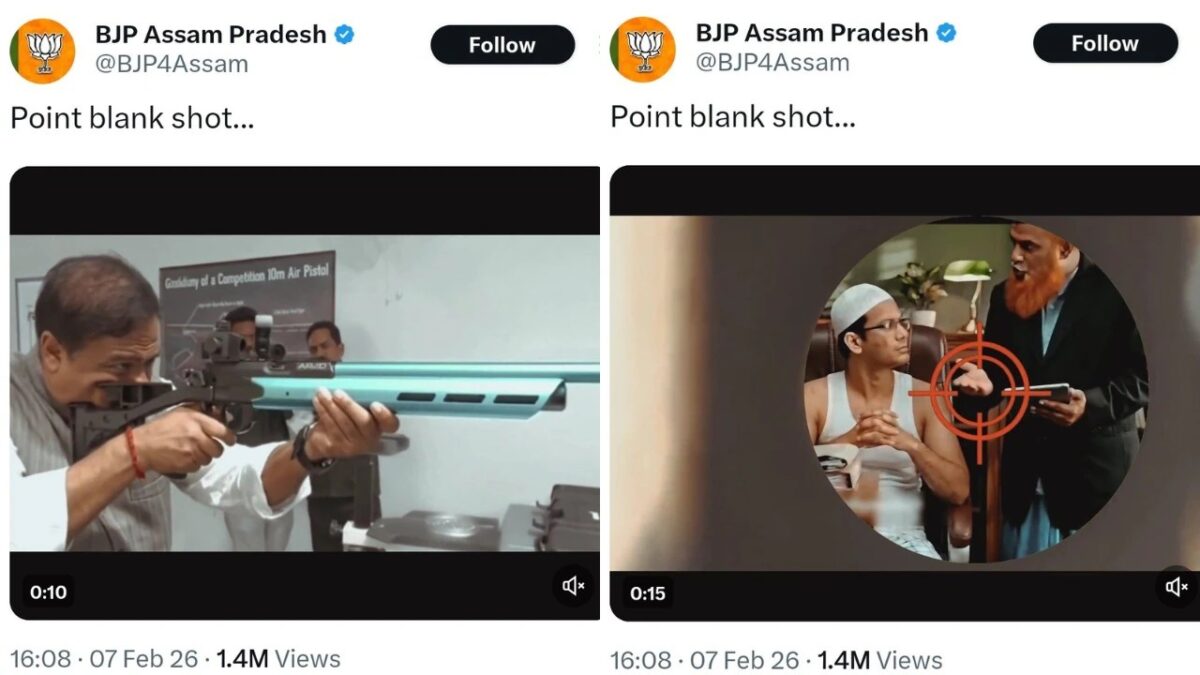
The investigation exposes how state branches of India’s ruling Bharatiya Janata Party (BJP) utilized generative artificial intelligence (AI) to create and disseminate anti-Muslim and anti-Bangladeshi propaganda. This digital campaign targeted the border states of Assam and West Bengal in December 2025 ahead of their legislative assembly elections scheduled for April 2026. And it has been identified dozens of videos uploaded by official BJP accounts utilizing AI tools to manipulate visuals and superimpose political figures into discriminatory contexts.
A prominent case study in Assam involved a video posted by the official BJP Assam branch. Consequently, featuring an AI-altered image depicting Assam Chief Minister Himanta Biswa Sarma shooting a bow and arrow at an image of two men in Muslim skull caps. One of the individuals depicted in the target photo was Gaurav Gogoi. A prominent leader of the opposition Indian National Congress (INC) party and a key BJP rival in Assam. Although Gogoi is Hindu, the video used an AI-generated image depicting him in a casual singlet and a Muslim skull cap to falsely label him. The video included captions such as “Foreigner-free Assam” and “Why did you not go to Pakistan?”, directly targeting the local Muslim and minority populations.
Furthermore, experts from the Center for the Study of Organized Hate (CSOH) note that Hindu far-right politicians have long utilized the trope of Muslims as “infiltrators” or illegal immigrants. Generative AI tools (such as Midjourney, Stable Diffusion, and DALL-E) act as a force multiplier, making it incredibly cheap and fast to create photorealistic disinformation. CSOH reports emphasize that these AI-generated visual campaigns reinforce strong associations between Muslim identity, illegality, and foreign status. By distorting reality, these tools are being effectively weaponized to justify exclusionary state policies and normalize street-level discrimination against minority groups in India.
In conclusion, the Bellingcat investigation highlights a dangerous evolution in political campaigning where generative AI is weaponized to manufacture and accelerate targeted disinformation. Indeed, by using sophisticated tools to fabricate photorealistic images that fuse political opposition with Islamophobic and xenophobic stereotypesm India’s ruling party has effectively lowered the cost and increased the speed of spreading hate speech. Ultimately, this integration of artificial intelligence into state-level politics does not just distort democratic discourse. It actively normalizes systemic discrimination and reinforces harmful, exclusionary narratives against minority populations.
Reference
Chaudhuri, P. (2026, March 31). How India’s Ruling Party is Using AI to Boost Hate Speech. Bellingcat. https://www.bellingcat.com/news/2026/03/31/india-bjp-hate-speech-ai/