
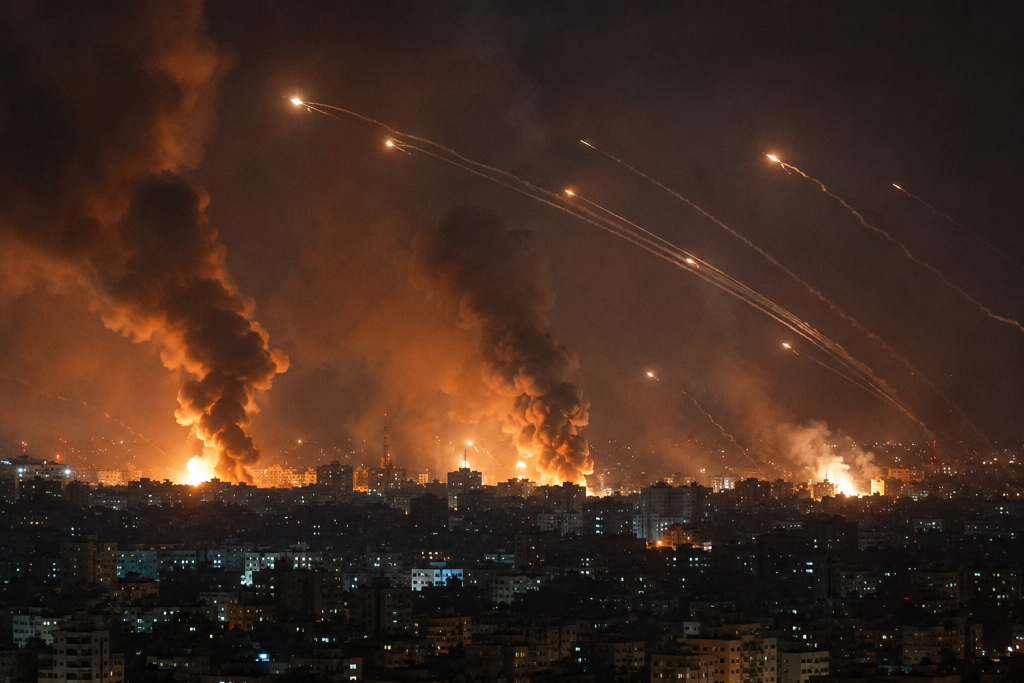
As the fragile Middle Eastern diplomatic track falls apart completely, the sudden US Airstrikes Iran infrastructure escalation marks a volatile return to open warfare. U.S. Central Command (CENTCOM) launched heavy overnight bombardments deliberately targeting critical transit and power corridors in southern Iran. This expanded campaign represents a direct attempt to force Tehran to ease its tight restrictions on the critical Strait of Hormuz shipping lane.
Strategic Logistics Bridges Reduced to Rubble
To understand the long-term impact of this aerial campaign, military planners are evaluating the severe damage dealt to domestic transport networks. Heavy precision munitions focused directly on southern Hormozgan province, striking key arterial structures near the coastal city of Bandar Khamir.
According to local administrative reports, multiple highway and railway bridges were completely destroyed, cutting off the vital port of Bandar Abbas from central transit corridors.
These tactical actions isolate the Islamic Republic’s primary maritime trade hub from the capital city of Tehran. Furthermore, the Iranian Energy Ministry confirmed widespread failures across the regional power grid for the first time. Consequently, this US Airstrikes Iran infrastructure escalation functions less as a localized border skirmish and more as a broad economic shutdown.
Key Surveillance Tower Collapses at Chabahar Port
The strategic campaign extended well beyond highway links into deep-water maritime installations. U.S. forces executed heavy strikes on the Gulf of Oman coastline, completely collapsing a major maritime tower at Chabahar port.
While Iranian media claimed the tower served purely commercial shipping lines, intelligence analysts offered a different assessment. CENTCOM officials confirmed the installation housed advanced tracking arrays used by the Islamic Revolutionary Guard Corps (IRGC) to target commercial container ships. As a result, the destruction removes a major radar asset from the waterway.
The Collapse of the Interim Ceasefire Deal
For international energy corridors and global finance, this sudden escalation signals a permanent collapse of recent peace talks. Iranian officials announced they have suspended all commitments under the interim deal signed last month.
Furthermore, the new Supreme Leader, Mojtaba Khamenei, issued his first broadcast statement warning of severe retaliation against Western interests. Diplomatic channels between Washington and Tehran are non-functional as both leadership groups prepare for an extended campaign. International commercial shipping firms are altering paths permanently, avoiding the Persian Gulf entirely due to high maritime safety risks.
A Highly Unstable Geopolitical Baseline
Restoring regional balance will require months of intense diplomatic mediation. The deliberate targeting of dual-use bridges and power lines has established a far more destructive baseline for international trade disputes.
Moving forward, cross-border businesses must adapt to a deeply fragmented maritime environment. Traditional global trade assumptions no longer hold true near these vital energy checkpoints. Ultimately, the immediate challenge for international forces is securing alternative supply lines before global markets face a historic supply shock.
Gambrell, J. (2026, July 17). US and Iran escalate strikes across Mideast; bridges and a water plant hit. Associated Press. https://apnews.com/article/iran-us-hormuz-strait-war-july-17-2026-2ad0cfe592eb258cb15a9eb04411d58a